
The theme over at Poetry Thursday this week is "If these walls could talk..."
Rather than walls, imagine this is coming from a car door. Also, my usual disclaimer: This was originally an attempt at writing a story in seven lines of prose. For the occasion that is Poetry Thursday, I've given it some line breaks, which I'm pretty sure doesn't necessarily make it a poem.
* * *
Erased it.
11.30.2006

Sunday Morning...
J.C. and I were bored and flipping through what was available on Showtime-On-Demand, even though, at the time, we didn't have Showtime. The second season of Weeds was on there, and so were the first eight or so episodes of Dexter, a new series based on the novel Darkly Dreaming Dexter, which I read the summer I was training pharmaceutical reps. We figured the ten bucks a month was worth it to spend a few hours Sunday watching TV, so I went downstairs and called the cable company and in ten minutes we were watching Weeds.
Three episodes into the second season, the phone started ringing. We don't have a phone upstairs, so I waited for the episode to finish, during which the phone rang yet another time, and then went downstairs to see who it was. The first call was my brother. The second, my parents. I called my parents first, and my mom answered.
"What's up?" I said.
"Umm, we're waiting for you."
"You are?"
"Yeah. It's grandma's birthday. Everyone's here."
Twenty minutes later we headed to my parents' place, feeling terrible, an hour late for my grandma's eightieth birthday party.
Three episodes into the second season, the phone started ringing. We don't have a phone upstairs, so I waited for the episode to finish, during which the phone rang yet another time, and then went downstairs to see who it was. The first call was my brother. The second, my parents. I called my parents first, and my mom answered.
"What's up?" I said.
"Umm, we're waiting for you."
"You are?"
"Yeah. It's grandma's birthday. Everyone's here."
Twenty minutes later we headed to my parents' place, feeling terrible, an hour late for my grandma's eightieth birthday party.
11.23.2006
On Thanksgiving...
and food trickery:
I dislike maybe three foods: olives, baked beans, and beets. When I was a kid, I disliked tomatoes, too, and every kind of bean, anything at all with a bean-y taste. My mom, when she would make chili, used to make me a bean-less batch. But eventually she got tired of making two pots of chili, so she began to puree the beans before she added them, and then she would say, "I made it special for you, Chad. No beans."
I would get all excited, because I liked bean-less chili, and then I would try it and I would taste beans. "This has beans in it, Mom," I would say. "I can taste them. Just because you put them in a blender doesn't mean they don't taste like beans anymore."
"No," she would say. "That's just the chili you're tasting."
I would eat a little, slowly, and fill myself up with slices of white bread.
I'm having Thanksgiving dinner tonight at my parents' place. When I asked my mom what she wanted me to bring, she told me deviled eggs and a salad. "A salad?" I asked.
"A fruit salad. A lettuce salad. Whatever."
I relayed this information to J.C. and we decided to to take a warm salad made with chopped Brussels sprouts and bacon. My mom hates Brussels sprouts, so I'm planning on telling her it's only cabbage. "It's like cole slaw," I'm going to tell her. "But warm. And with bacon and red-wine vinegar and olive oil instead of sliced carrots and mayonnaise."
"Oh," she will say. "That sounds interesting."
"Yeah, Mom," I will say. "And you do love cole slaw."
I dislike maybe three foods: olives, baked beans, and beets. When I was a kid, I disliked tomatoes, too, and every kind of bean, anything at all with a bean-y taste. My mom, when she would make chili, used to make me a bean-less batch. But eventually she got tired of making two pots of chili, so she began to puree the beans before she added them, and then she would say, "I made it special for you, Chad. No beans."
I would get all excited, because I liked bean-less chili, and then I would try it and I would taste beans. "This has beans in it, Mom," I would say. "I can taste them. Just because you put them in a blender doesn't mean they don't taste like beans anymore."
"No," she would say. "That's just the chili you're tasting."
I would eat a little, slowly, and fill myself up with slices of white bread.
I'm having Thanksgiving dinner tonight at my parents' place. When I asked my mom what she wanted me to bring, she told me deviled eggs and a salad. "A salad?" I asked.
"A fruit salad. A lettuce salad. Whatever."
I relayed this information to J.C. and we decided to to take a warm salad made with chopped Brussels sprouts and bacon. My mom hates Brussels sprouts, so I'm planning on telling her it's only cabbage. "It's like cole slaw," I'm going to tell her. "But warm. And with bacon and red-wine vinegar and olive oil instead of sliced carrots and mayonnaise."
"Oh," she will say. "That sounds interesting."
"Yeah, Mom," I will say. "And you do love cole slaw."
11.22.2006
11.21.2006
Illinois' Smallest Library
It's been quite a few weeks since we drove the Knox County/Spoon River Scenic Drives, but I still have a number of pics from the trip. Today's feature, as the title suggests, is Illinois' smallest public library, located in Ellisville.

We spotted the sign (minus the apostrophe) just after we perused Ellisville's Scarecrow Contest and while we were waiting on our walleye sandwiches to fry up in the Walleye Truck (which we thought was unique to Ellisville but later realized was not, when we found them at a few other locations that day).

Eventually, stuffed with fish, we made our way down the street to the library, and once we were inside, the librarian handed us business cards she'd printed from a computer on regular old 20 lb. printer paper. I don't have a picture of the card, but it's on our refrigerator. When the woman handed it to me, she said, "Here. Have a memory."
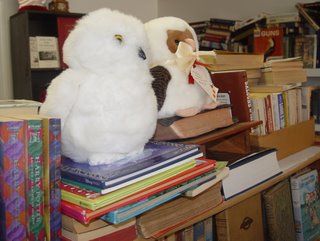
It didn't take long to see the place. The above pic was taken from about the middle of the building, and that's the back wall. Once we'd seen what we wanted to see, we talked to the librarian for a few minutes. She'd established the library in 1966, and since all of us present were book people, we assumed she was too, so we chatted, told her how great it was that she had established and run the library as an unpaid volunteer for forty years. Eventually, though, she kind of advocated book burning. The gist of it: She thought that it was easier for parents to monitor their kids' book-reading habits than it is to monitor what they look at on the Internet. Because, you know, if parents find the kid with a book they disapprove of, then they can always throw it on the pyre.
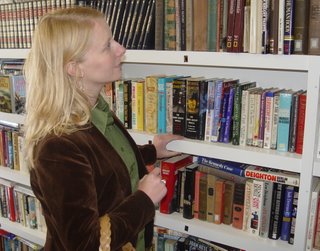
It would be great if I had a picture of a book-burning pyre to put here, but since I don't, here's J.C., posing. I believe this is her "All I Have in the World" blog debut.
In case y'all are wondering: The library relies entirely on donations, and we did find a number of good books there. Lots of crime novels, and romances, but also some Lorrie Moore and Cormac McCarthy, and, of course, multiple copies of pretty much every book Oprah has ever selected for her book club.
If I ever publish a book, I'm going to hand-deliver a copy or two to this place, so long as the librarian promises not to burn it. Or stick it on the "free" table outside, where J.C. happened to pick up that day a copy of The Book of Mormon.

We spotted the sign (minus the apostrophe) just after we perused Ellisville's Scarecrow Contest and while we were waiting on our walleye sandwiches to fry up in the Walleye Truck (which we thought was unique to Ellisville but later realized was not, when we found them at a few other locations that day).

Eventually, stuffed with fish, we made our way down the street to the library, and once we were inside, the librarian handed us business cards she'd printed from a computer on regular old 20 lb. printer paper. I don't have a picture of the card, but it's on our refrigerator. When the woman handed it to me, she said, "Here. Have a memory."

It didn't take long to see the place. The above pic was taken from about the middle of the building, and that's the back wall. Once we'd seen what we wanted to see, we talked to the librarian for a few minutes. She'd established the library in 1966, and since all of us present were book people, we assumed she was too, so we chatted, told her how great it was that she had established and run the library as an unpaid volunteer for forty years. Eventually, though, she kind of advocated book burning. The gist of it: She thought that it was easier for parents to monitor their kids' book-reading habits than it is to monitor what they look at on the Internet. Because, you know, if parents find the kid with a book they disapprove of, then they can always throw it on the pyre.

It would be great if I had a picture of a book-burning pyre to put here, but since I don't, here's J.C., posing. I believe this is her "All I Have in the World" blog debut.
In case y'all are wondering: The library relies entirely on donations, and we did find a number of good books there. Lots of crime novels, and romances, but also some Lorrie Moore and Cormac McCarthy, and, of course, multiple copies of pretty much every book Oprah has ever selected for her book club.
If I ever publish a book, I'm going to hand-deliver a copy or two to this place, so long as the librarian promises not to burn it. Or stick it on the "free" table outside, where J.C. happened to pick up that day a copy of The Book of Mormon.
11.20.2006
Rental
He did something yesterday he hadn't done in a long while. He stayed up most of the night reading. Cormac McCararthy's The Road.
The morning following he is tired. There is a film like liquid ash over his eyes and his eyes burn and his head is filled up with the sound of McCarthy's voice and with the boy's goodness and heartbreak.
He should write a review of the book. Because he's a writer. He's never cared much for reviews though. He thinks they require a kind of intelligence he doesnt quite possess. A slippery kind, capable of snaking beneath the hard crust of meaning into the mushy quicksand form.
And he cant get that film of liquid ash out of his eyes. There is gray and gray cat vomit in the floor. His coffee is gray and the boneweary tiredness he feels in his face and legs and even his fingers is gray too. All ash.
* * *
I actually checked the book out of the library last week. There are two new release shelves at the Galesburg Public Library: One is a fairly standard shelf filled with books released the past four or five months--lots of subpar genre and the occasional short story collection and literary novel; the day I got The Road I checked out, for J.C., for instance, Shelley Jackson's Half Life. The other shelf is smaller, off to the side, and filled with the more popular stuff. It's for rentals. Fifty cents a week. The Road was on this shelf, and it was the first time I ever paid money at the GPL for a book. (Actually, I almost got out of the library without having to pay because the librarian forgot to ask for my two quarters. I already had them in my hand when I started to walk away, and then I remembered, reminded her. O, how grateful she was, and how good I felt for being honest and charitable, etc.)
Anyway, the book is due tomorrow, and as of yesterday I'd only made it through the first seventy pages or so. I had been excited to read the book--practically everyone I'd talked to who's read it had told me it was great.
And when I started reading the book, I was intrigued for the first forty pages, and dazzled, of course, by the virtuosity of McCarthy's vision and style. The next thirty pages, though, took me a couple days to read. I just couldn't get into them, and I actually wanted to make a Mad-Lib out of the book by taking out all of the words "blackened" and "ash." I still think it would be kind of fun.
So last night I got to about page ninety, a kind of pivotal and very frightening moment in the book, and I didn't put it down after that. I was dazzled and afraid and moved. The book trembled in my hands. Like flakes of ash. For a number of reasons.
I realize the stuff that frustrated me was probably necessary for the set-up and pacing of what was to come, but despite how much I ended up liking the thing, pages forty to seventy or so really were difficult for me to get through.
Since this isn't really a review, I have a question for any readers out there who have read the book and may happen upon this entry: What is with that first-person passage on page seventy-four. It kind of came out of nowhere, and I expected its significance to return in some way later on, but it never really did. Any ideas out there? I thought, in retrospect, it might be the voice of the guy whom the boy later meets up with, but I just re-read it, and obviously it's not. So, anyone know what's up with it?
I have another question, too. This one's content- and not form-related: If the boy was born into this world, how, exactly, does he find it so terrifying? In other words, if you are born in an outhouse, do you not quickly acclimate to the smell of dung and urine, because you know nothing else? It seems McCarthy attempts to answer this in his descriptions of the boy throughout the book, pointing out he is special and whatnot, but I still found myself wondering.
If anyone's still reading: If you haven't rented a book from the library and then stayed up until four in the morning to finish it in a while, I highly recommend doing so. Despite this film of ash on my eyes. How slowly the world creeps back to life. In the end it is worth it.
The morning following he is tired. There is a film like liquid ash over his eyes and his eyes burn and his head is filled up with the sound of McCarthy's voice and with the boy's goodness and heartbreak.
He should write a review of the book. Because he's a writer. He's never cared much for reviews though. He thinks they require a kind of intelligence he doesnt quite possess. A slippery kind, capable of snaking beneath the hard crust of meaning into the mushy quicksand form.
And he cant get that film of liquid ash out of his eyes. There is gray and gray cat vomit in the floor. His coffee is gray and the boneweary tiredness he feels in his face and legs and even his fingers is gray too. All ash.
* * *
I actually checked the book out of the library last week. There are two new release shelves at the Galesburg Public Library: One is a fairly standard shelf filled with books released the past four or five months--lots of subpar genre and the occasional short story collection and literary novel; the day I got The Road I checked out, for J.C., for instance, Shelley Jackson's Half Life. The other shelf is smaller, off to the side, and filled with the more popular stuff. It's for rentals. Fifty cents a week. The Road was on this shelf, and it was the first time I ever paid money at the GPL for a book. (Actually, I almost got out of the library without having to pay because the librarian forgot to ask for my two quarters. I already had them in my hand when I started to walk away, and then I remembered, reminded her. O, how grateful she was, and how good I felt for being honest and charitable, etc.)
Anyway, the book is due tomorrow, and as of yesterday I'd only made it through the first seventy pages or so. I had been excited to read the book--practically everyone I'd talked to who's read it had told me it was great.
And when I started reading the book, I was intrigued for the first forty pages, and dazzled, of course, by the virtuosity of McCarthy's vision and style. The next thirty pages, though, took me a couple days to read. I just couldn't get into them, and I actually wanted to make a Mad-Lib out of the book by taking out all of the words "blackened" and "ash." I still think it would be kind of fun.
So last night I got to about page ninety, a kind of pivotal and very frightening moment in the book, and I didn't put it down after that. I was dazzled and afraid and moved. The book trembled in my hands. Like flakes of ash. For a number of reasons.
I realize the stuff that frustrated me was probably necessary for the set-up and pacing of what was to come, but despite how much I ended up liking the thing, pages forty to seventy or so really were difficult for me to get through.
Since this isn't really a review, I have a question for any readers out there who have read the book and may happen upon this entry: What is with that first-person passage on page seventy-four. It kind of came out of nowhere, and I expected its significance to return in some way later on, but it never really did. Any ideas out there? I thought, in retrospect, it might be the voice of the guy whom the boy later meets up with, but I just re-read it, and obviously it's not. So, anyone know what's up with it?
I have another question, too. This one's content- and not form-related: If the boy was born into this world, how, exactly, does he find it so terrifying? In other words, if you are born in an outhouse, do you not quickly acclimate to the smell of dung and urine, because you know nothing else? It seems McCarthy attempts to answer this in his descriptions of the boy throughout the book, pointing out he is special and whatnot, but I still found myself wondering.
If anyone's still reading: If you haven't rented a book from the library and then stayed up until four in the morning to finish it in a while, I highly recommend doing so. Despite this film of ash on my eyes. How slowly the world creeps back to life. In the end it is worth it.
11.17.2006
Another Question for the Universe
Last December, I received word from a literary magazine that they wanted to publish one of my stories.
This sounds like a fine and dandy thing, I know, but here's the deal: I'd submitted the story to the magazine as part of a pretty well-renowned contest. My story hadn't won the contest, but the magazine thought enough of my submission that they wanted to publish it. At the time, the story was still a finalist in a few contests, and under consideration at a few other magazines, so I told the magazine in question, "Thanks, but no thanks." I didn't think it was too big of a deal. I mean, they had written me for permission to publish the thing.
Now, though, almost a full year later, the story in question remains unpublished. And my question for you, universe, is: Did I anger the karmic gods here? Was I greedy, or self-important? Did I screw up?
Talking about submissions, of course, and about slightly paranoid delusions, makes me think of J.C.
I can hear her already, saying, "Didn't you just, like three days ago, quote Marlo Stanfield's philosophy, 'You can't lose if you don't play the game'?"
"You're right," I tell her. "I did say that."
"And if the story's good enough to get accepted by one magazine," she's saying, "aren't the odds pretty good it'll get accepted by another?"
"Yes," I say. "The odds are pretty good."
"Then knock all this stuff off," she says. "Geesh. The 'Karmic Gods'? Are you kidding me?"
This sounds like a fine and dandy thing, I know, but here's the deal: I'd submitted the story to the magazine as part of a pretty well-renowned contest. My story hadn't won the contest, but the magazine thought enough of my submission that they wanted to publish it. At the time, the story was still a finalist in a few contests, and under consideration at a few other magazines, so I told the magazine in question, "Thanks, but no thanks." I didn't think it was too big of a deal. I mean, they had written me for permission to publish the thing.
Now, though, almost a full year later, the story in question remains unpublished. And my question for you, universe, is: Did I anger the karmic gods here? Was I greedy, or self-important? Did I screw up?
Talking about submissions, of course, and about slightly paranoid delusions, makes me think of J.C.
I can hear her already, saying, "Didn't you just, like three days ago, quote Marlo Stanfield's philosophy, 'You can't lose if you don't play the game'?"
"You're right," I tell her. "I did say that."
"And if the story's good enough to get accepted by one magazine," she's saying, "aren't the odds pretty good it'll get accepted by another?"
"Yes," I say. "The odds are pretty good."
"Then knock all this stuff off," she says. "Geesh. The 'Karmic Gods'? Are you kidding me?"
11.14.2006
Pillow Talk
Tonight, before she left for a meeting, J.C. and I were sitting in the dark of our TV room, our faces illuminated only by the C.S.I episode playing on the tube in the corner, and she looked over at me, said, "Sometimes, when I see you sitting beside me like this, you look like a middle-aged man--from the early '80's."
Philosophy 101
from Romeo and Juliet, Act I, Scene IV
Romeo:
A torch for me. Let wantons light of heart
Tickle the senseless rushes with their heels.
For I am proverbed with a grandsire phrase,
I'll be a candle holder, and look on.
The game was ne'er so fair, and I am done.
* * *
To paraphrase, here's Marlo Stanfield in a recent episode of The Wire:
You can't lose if you don't play the game.
Romeo:
A torch for me. Let wantons light of heart
Tickle the senseless rushes with their heels.
For I am proverbed with a grandsire phrase,
I'll be a candle holder, and look on.
The game was ne'er so fair, and I am done.
* * *
To paraphrase, here's Marlo Stanfield in a recent episode of The Wire:
You can't lose if you don't play the game.
Resource
The amazing Pia Z. Ehrhardt has an interview with one of my favorite writers, Ron Carlson, over at Quick Fiction.
Though he is one of my favorite short-story writers, I forget about Ron Carlson every now and then. And I just now realized that I haven't once taught a Ron Carlson story. This is going to change soon.
Also, after you read the interview, answer me this: How eloquent is that guy? One of my teachers attended a conference once where Mr. Carlson was the featured speaker, and afterwards, my teacher said Carlson was so charming and good-looking and eloquent--and, of course, such a great writer--that he started hoping the guy would slip-up just once, and say something stupid, or show up for his keynote address with mustard on the lapel of his sport coat.
Though he is one of my favorite short-story writers, I forget about Ron Carlson every now and then. And I just now realized that I haven't once taught a Ron Carlson story. This is going to change soon.
Also, after you read the interview, answer me this: How eloquent is that guy? One of my teachers attended a conference once where Mr. Carlson was the featured speaker, and afterwards, my teacher said Carlson was so charming and good-looking and eloquent--and, of course, such a great writer--that he started hoping the guy would slip-up just once, and say something stupid, or show up for his keynote address with mustard on the lapel of his sport coat.
Seven Lines
Opium Magazine is taking submissions from now until December 15th for The Shya Scanlon Seven-Line Prose Award. It's pretty much just what it sounds like: A prize for the best seven-line story. A thousand bucks. That's like, what, $140 per line? About $10 per word? I'm pretty sure that's more than even The New Yorker pays. But it will cost you a seven-dollar entry fee for a shot at the cash. Why don't you go and give it a try?
I worked on a story over the weekend that I plan to submit. I'd written a few thousand words on a story called "Amtrak," and I managed to whittle it down to seven lines--113 words. Also, since yesterday was the last day of classes, I had my Beginning Fiction class bring seven-line stories of their own to class, and the results were pretty impressive.
For my two or three regular readers out there: This is my 100th post. I've so been keeping a couple Coors Lights in the fridge for just such an occasion.
I worked on a story over the weekend that I plan to submit. I'd written a few thousand words on a story called "Amtrak," and I managed to whittle it down to seven lines--113 words. Also, since yesterday was the last day of classes, I had my Beginning Fiction class bring seven-line stories of their own to class, and the results were pretty impressive.
For my two or three regular readers out there: This is my 100th post. I've so been keeping a couple Coors Lights in the fridge for just such an occasion.
11.10.2006
End of the Term Madness, Part I
Things aren't too crazy around here, but, um, a few minutes ago, while washing my hands in the bathroom, I tried to receive soap from the paper towel dispenser.
11.09.2006
Poetry Thursday--Abdications
This is a pretty old poem of mine that I think jibes fairly well with this week's theme over at Poetry Thursday. I know the lines are a little off, but remember, I'm a fiction writer, not a poet, and I just can't capture "the line" the way, say, Alan Dugan can. I do wish I could, though.
* * *
The Pleasure of Ephemera
When I reach my lowest
I go to George’s
Antiques and look through
other people’s
abdications. Today,
I find a postcard:
two keystone cops asleep
on what looks like
a tomato. The message
reads: This place
is so exciting I found
two policemen sleeping
on the beet. Beneath the message,
Lizzie wrote to Clara,
Why don’t you come
and visit sometime
before she walked out of her house
in 1923 Murphysboro and made,
out of rose petals and the stems
of stargazer lilies, a ukulele
she played— while riding in
a wooden wheelbarrow—
every day the sun shone
like something
that had been lost
for days and then
suddenly found.
* * *
The Pleasure of Ephemera
When I reach my lowest
I go to George’s
Antiques and look through
other people’s
abdications. Today,
I find a postcard:
two keystone cops asleep
on what looks like
a tomato. The message
reads: This place
is so exciting I found
two policemen sleeping
on the beet. Beneath the message,
Lizzie wrote to Clara,
Why don’t you come
and visit sometime
before she walked out of her house
in 1923 Murphysboro and made,
out of rose petals and the stems
of stargazer lilies, a ukulele
she played— while riding in
a wooden wheelbarrow—
every day the sun shone
like something
that had been lost
for days and then
suddenly found.
11.07.2006
Dzanc Books
Over at the Emerging Writers Network, Dan Wickett has announced Dzanc Books' first title. All Over, by the estimable Roy Kesey, will be published in October 2007. If you remember my post from a few days back, Mr. Kesey's novella, Nothing in the World, is on its way to my house as I type.
If you don't know who Roy Kesey is, head on over to his website, find his bio, and click on the links to a few of his stories. You will be thrilled that you did. Also, go check out his blog on his myspace page. It's pretty entertaining--his stories about his kids are so damn cute they make me wish--for, oh, about twelve seconds or so--that I had a couple of my own. Kids, that is. Not his stories about his kids.
* * *
Dzanc Books, if I remember correctly from the press' announcement, is going to publish both short story collections and novels. I think it's wicked cool, of course, that their inaugural book is going to be stories. On Sunday, while I was cleaning the house and had nothing better to do with my brain as I scrubbed the toilets and mopped the floors, I was thinking about how great it would be if some press devoted itself wholly to publishing short fiction.
I know, the market says this would be a losing enterprise, but still, I wonder what would happen if a publisher marketed itself as the publisher of short fiction. They could do paperback originals, like the old Vintage Contemporaries, and make them pretty, and have a diverse catalog and all that. If I had a bundle of money that I didn't mind losing just sitting around, I'd like to give it a try, just to see what would happen.
If you don't know who Roy Kesey is, head on over to his website, find his bio, and click on the links to a few of his stories. You will be thrilled that you did. Also, go check out his blog on his myspace page. It's pretty entertaining--his stories about his kids are so damn cute they make me wish--for, oh, about twelve seconds or so--that I had a couple of my own. Kids, that is. Not his stories about his kids.
* * *
Dzanc Books, if I remember correctly from the press' announcement, is going to publish both short story collections and novels. I think it's wicked cool, of course, that their inaugural book is going to be stories. On Sunday, while I was cleaning the house and had nothing better to do with my brain as I scrubbed the toilets and mopped the floors, I was thinking about how great it would be if some press devoted itself wholly to publishing short fiction.
I know, the market says this would be a losing enterprise, but still, I wonder what would happen if a publisher marketed itself as the publisher of short fiction. They could do paperback originals, like the old Vintage Contemporaries, and make them pretty, and have a diverse catalog and all that. If I had a bundle of money that I didn't mind losing just sitting around, I'd like to give it a try, just to see what would happen.
Carrie Wins, Faith Gets, Um, Upset?
I saw this over at my favorite trashy celebrity website, Perez Hilton, and I imagine most of the people who stop by here will have already seen it, but I'm posting it because I want to know what you think: Is Faith really upset or is she playing?
The first time I saw the video I thought it was a ruse, but now I'm pretty sure she's pissed. When they announce the nominees, check out the difference between the way Ms. Hill reacts to her name and the way Gretchen Wilson does.
Also, I'd love to see reactions like this at the National Book Award ceremony.
I saw this over at my favorite trashy celebrity website, Perez Hilton, and I imagine most of the people who stop by here will have already seen it, but I'm posting it because I want to know what you think: Is Faith really upset or is she playing?
The first time I saw the video I thought it was a ruse, but now I'm pretty sure she's pissed. When they announce the nominees, check out the difference between the way Ms. Hill reacts to her name and the way Gretchen Wilson does.
Also, I'd love to see reactions like this at the National Book Award ceremony.
11.06.2006
Call It A Term
It's the last week of classes here in Galesburg.
Well, the last full week of classes. My Beginning Fiction class meets next Monday. After that, I'll read some portfolios, assign grades, and call it a term.
For those of you who may care, on Friday night, I finished edits on a chapbook of ten flash and short-short stories, which I'll soon be sending out to a few contests. You can, you know, wish me luck in comments or something. If you want.
Well, the last full week of classes. My Beginning Fiction class meets next Monday. After that, I'll read some portfolios, assign grades, and call it a term.
For those of you who may care, on Friday night, I finished edits on a chapbook of ten flash and short-short stories, which I'll soon be sending out to a few contests. You can, you know, wish me luck in comments or something. If you want.
11.03.2006
A Question for the Universe
or, more precisely, for my two or three readers.
Here's the deal: I came across a notice the other day that mentioned a forthcoming theme issue from a very cool literary magazine. My initial reaction was something like, "Ooh. Ooh. I know just what I'm going to send them." I typed up the cover letter, retrieved a manila envelope and an SASE, printed out the story.
I did all those things, yet the materials are still sitting on my desk. The problem is that magazines don't allow you, in general, to submit more than one story at a time to them, and I already have a story under consideration at this same magazine, which I sent before they announced the forthcoming theme issue.
I considered sending the new story with a cover letter that explained I was knowingly breaking the rules, but I'm pretty sure that would just annoy them. I also considered sending the thing under J.C.'s name or something, but, you know, that's just silly.
So, I can wait for a response from the other story and then send the new one, but the deadline for the theme issue is coming up pretty soon, and the magazine advised people to send their stuff as soon as possible.
So, universe, what should I do?
Now that I've typed all that out, I'm hearing J.C.'s voice in the back of my brain. She's telling me that I live in a bubble, that I need some real things to worry about.
"But I'm not really worrying about this stuff," I tell her. "It's just a little predicament I wanted to throw onto the blog."
"Really," she's telling me. "You need to get out more. Don't you have some student stories to mark up or something?"
"Yes," I say. "I do."
"That's what I thought," she says. "Why don't you go and do that, stop worrying about this crap."
"Okay," I say, and I'm so demure, so intent now on forgetting I ever brought this dilemma up, that I don't even curse her for my imagining her putting me in my place.
Here's the deal: I came across a notice the other day that mentioned a forthcoming theme issue from a very cool literary magazine. My initial reaction was something like, "Ooh. Ooh. I know just what I'm going to send them." I typed up the cover letter, retrieved a manila envelope and an SASE, printed out the story.
I did all those things, yet the materials are still sitting on my desk. The problem is that magazines don't allow you, in general, to submit more than one story at a time to them, and I already have a story under consideration at this same magazine, which I sent before they announced the forthcoming theme issue.
I considered sending the new story with a cover letter that explained I was knowingly breaking the rules, but I'm pretty sure that would just annoy them. I also considered sending the thing under J.C.'s name or something, but, you know, that's just silly.
So, I can wait for a response from the other story and then send the new one, but the deadline for the theme issue is coming up pretty soon, and the magazine advised people to send their stuff as soon as possible.
So, universe, what should I do?
Now that I've typed all that out, I'm hearing J.C.'s voice in the back of my brain. She's telling me that I live in a bubble, that I need some real things to worry about.
"But I'm not really worrying about this stuff," I tell her. "It's just a little predicament I wanted to throw onto the blog."
"Really," she's telling me. "You need to get out more. Don't you have some student stories to mark up or something?"
"Yes," I say. "I do."
"That's what I thought," she says. "Why don't you go and do that, stop worrying about this crap."
"Okay," I say, and I'm so demure, so intent now on forgetting I ever brought this dilemma up, that I don't even curse her for my imagining her putting me in my place.
The Nietzsche Family Circus
The rumors are true: Nietzsche's words have paired up with Family Circus cartoons, and the results, on occasion, are pretty hilarious. You can go here for a random sample. If you don't love the first one that pops up, just refresh until one delights you.
Or, you can follow the permalinks below:
On Writing
On Suicide
And, Well, Because Halloween Was Just A Few Days Ago
Or, you can follow the permalinks below:
On Writing
On Suicide
And, Well, Because Halloween Was Just A Few Days Ago
11.02.2006
Miranda, Miranda
A few years ago, I attended a poetry reading given by Thomas Lux. I was pretty unfamiliar with his poems at the time, but he gave a great reading, read some great poems. About the poems, I remember only that there was one about a spider, but I remember quite a bit of what he said by way of an introduction to a certain, different poem. Lux said that he often gets asked at poetry readings and by students what he thinks of Bob Dylan's lyrics as poetry. His response to this question, rather than actually addressing the quality of Dylan's lyrics as poetry, was to say something like, "Bob Dylan is one of the greatest songwriters of all time. Can't he just be that? Why do we have to think of him as a poet, too?"
I mention this because I've been reading some of Miranda July's stories lately. Most of you probably know already that she wrote and directed "Me and You and Everyone We Know," which is my favorite movie of the past three or four years. I loved the writing, the images, the characters, the back-and-forth, all that.
Now, it's true: Before, or while she was making films, and multimedia art, and performance CDs, July was also publishing short stories in places like The Mississippi Review, and Fence, and Harvard Review. In the past year or so, though, since making her spectacular movie, her stories have continued to pop up in places like The New Yorker, Zoetrope, The Paris Review.
And what I want to say is: Can't you just make great movies?
I would amend Lux's last statement, though, to say: Why do you have to write great short stories, too?
Because the truth is, July's stories knock me flat. You can read "The Shared Patio" here. And her most recent story, published in the September 18th issue of The New Yorker, will certainly wind up anthologized next year. The story, "Something That Needs Nothing," is unavailable online for some reason, but you can go to your local library, like I did, and make a photocopy of the story, and carry it around in your pocket forever for the mere price of one dollar. You know, provided your local library only charges you ten cents a page.
And next year, in May, Scribner is going to release her collection, "No One Belongs Here More Than You: Stories."
I can't wait.
I mention this because I've been reading some of Miranda July's stories lately. Most of you probably know already that she wrote and directed "Me and You and Everyone We Know," which is my favorite movie of the past three or four years. I loved the writing, the images, the characters, the back-and-forth, all that.
Now, it's true: Before, or while she was making films, and multimedia art, and performance CDs, July was also publishing short stories in places like The Mississippi Review, and Fence, and Harvard Review. In the past year or so, though, since making her spectacular movie, her stories have continued to pop up in places like The New Yorker, Zoetrope, The Paris Review.
And what I want to say is: Can't you just make great movies?
I would amend Lux's last statement, though, to say: Why do you have to write great short stories, too?
Because the truth is, July's stories knock me flat. You can read "The Shared Patio" here. And her most recent story, published in the September 18th issue of The New Yorker, will certainly wind up anthologized next year. The story, "Something That Needs Nothing," is unavailable online for some reason, but you can go to your local library, like I did, and make a photocopy of the story, and carry it around in your pocket forever for the mere price of one dollar. You know, provided your local library only charges you ten cents a page.
And next year, in May, Scribner is going to release her collection, "No One Belongs Here More Than You: Stories."
I can't wait.
Subscribe to:
Posts (Atom)
