
Last year around this time I became a little inspired by my students. It was an odd kind of inspiration, and I’m not sure I’m fit this morning to put it into words, but since I’m here I’ll try.
I’ll begin like this: When I was in college, I typed out passages of stories or poems I liked and taped them to my walls—really, I papered my room with them. I memorized “The Emperor of Ice Cream” and “To Elsie” and most of “The Love Song of J. Alfred Prufrock.” I leaned a picture postcard of Raymond Carver against my computer screen, and for a good while, I read "A Clean Well Lighted Place" every night before I went to bed.
But besides these writer-ly things, I also went over to the house where J.C. lived with a few friends of hers the first time they tried to make focaccia bread. We may or may not have had flavored coffee that night. Nutmeg. I couldn’t believe coffee could smell like that. It blew me away. And, sometimes, I’d stay up all night, reading William Gass or Don DeLillo or Nathanael West, or listening to R.E.M. or Radiohead or Bob Dylan and I’d think about the smell of flavored coffee and what focaccia bread tastes like when dipped in pesto. And sometimes, when I wasn't in the mood to sit around the house all night, I’d get in the car and just drive, without direction, to see where I wound up.
Time, though, passes. Fast forward eight or nine years, and I’m sitting in my office listening to students tell me about books they’re nuts for, or about road trips they’ve taken, or how they’re trying to bake the perfect gingerbread cookie or knit scarves for their closest twenty friends. I’m listening to them tell me what’s on their iPods and about the art installations they’re working on, or how they’re trying to learn Korean in their spare time.
Last year, listening to my students, I couldn’t help but wonder when I stopped doing some of the things they were doing, when I stopped craving new experiences, going in search of them.
Don’t get me wrong. I do not long to be twenty again. The typical student I’m talking about, though bright and utterly interesting, tends to be cynical, even, at times, less than empathetic. I’ll remain thirty, no problem.
But I made a little vow to myself to get back to being young again in certain ways—and I began by deciding to memorize a poem every now and then. The first poem I chose was James Wright’s “Autumn Begins in Martins Ferry, Ohio” (which is, I suppose, appropriate as a response to both this post and the imminent season):
Autumn Begins in Martins Ferry, Ohio
In the Shreve High football stadium,
I think of Polacks nursing long beers in Tiltonsville,
And gray faces of Negroes in the blast furnace at Benwood,
And the ruptured night watchman of Wheeling Steel,
Dreaming of heroes.
All the proud fathers are ashamed to go home.
Their women cluck like starved pullets,
Dying for love.
Therefore,
Their sons grow suicidally beautiful
At the beginning of October,
And gallop terribly against each other's bodies.
* * *
For more poetry head this way.
8.31.2006

8.30.2006
Publishing, Etc.
On the eve of Kyle Minor day here at "All I Have in the World," I received news that a story of mine was accepted at juked. I'm quite stoked, as I love the stuff they post over there, particularly "My Robot" by Claudia Smith and "only bastard in town who prefers brunettes" by Elizabeth Ellen and "Aching Hours" by Douglas Light. For now, if you haven't already read those stories, go check them out; I'll let you know when my story becomes available.
And on a related note: Though I write here every now and then about what I'm writing and reading, I tend to avoid writing about the whole business side of writing: submitting stories for publication. For those of you who may be interested, I have, I think, ten story-type-things (some are very short--300 words or so--and some are longer--more like 5,000 words or so) under consideration for publication at various magazines, contests, and anthologies. I keep pretty thorough records of all this, both in a MS Word document and over at Duotrope's Digest, which is an excellent resource for writers and has become a minor obsession of mine--seriously, I think I'm going to have to donate some money to them once I get paid in October.
Ten minutes ago, I did a brief sweep of both my Word doc and Duotrope to see how many rejections I've received for those ten story-type-things since I received my last acceptance for a story-type-thing. This was an odd thing to do for me, as I tend to focus my attention more on where I have things out currently, and where I plan on sending more stuff than I do on those lines in the Word doc that say "dumbass form rejection" or "nice, handwritten letter encouraging me to submit again" or "maybe I forgot to include an SASE?"
So, my last acceptance was received on May 25, 2006, just over three months ago. For some reason, three months seems to be the average "drought" period for me between acceptances. In fact, I published my first story in November 2003, and this most recent publication will mark the ninth appearance of my work either in print or online. *doing math in my head* *getting out a piece of scratch paper, because the whole math-in-my-head thing isn't working* Okay, that's thirty-four months, nine stories, which averages out to a story every 3 1/2 months or so. Dang, and here I thought I was just making stuff up when I said that thing about three months being the average "drought" period.
Anyway. All this build-up...I should just type down the number already. How many rejections has Chad received since May 25, 2006? (Did I just write about myself in third-person? I did. Or Chad did. Please forgive me/him.)
*quiet drum roll*
*getting even quieter, and slower, more like a resting hearbeat really than someone playing the drums*
Twenty-three rejections, for eight of the ten story-type-things I have in circulation.
I feel so naked right now.
In order to end an a less-exposed note: Big thanks to those of you who sent Kyle or me comments about the interview I posted yesterday. And much thanks to Kyle for agreeing to participate in the whole thing. I had a blast--and I absolutely love that essay of his. If you're in a bookstore sometime soon, spend the $13.00 on the anthology. Seriously, his essay alone is worth the price, and I'm guessing, based on his effort, that the editors filled the thing with plenty of other excellent stuff too.
And on a related note: Though I write here every now and then about what I'm writing and reading, I tend to avoid writing about the whole business side of writing: submitting stories for publication. For those of you who may be interested, I have, I think, ten story-type-things (some are very short--300 words or so--and some are longer--more like 5,000 words or so) under consideration for publication at various magazines, contests, and anthologies. I keep pretty thorough records of all this, both in a MS Word document and over at Duotrope's Digest, which is an excellent resource for writers and has become a minor obsession of mine--seriously, I think I'm going to have to donate some money to them once I get paid in October.
Ten minutes ago, I did a brief sweep of both my Word doc and Duotrope to see how many rejections I've received for those ten story-type-things since I received my last acceptance for a story-type-thing. This was an odd thing to do for me, as I tend to focus my attention more on where I have things out currently, and where I plan on sending more stuff than I do on those lines in the Word doc that say "dumbass form rejection" or "nice, handwritten letter encouraging me to submit again" or "maybe I forgot to include an SASE?"
So, my last acceptance was received on May 25, 2006, just over three months ago. For some reason, three months seems to be the average "drought" period for me between acceptances. In fact, I published my first story in November 2003, and this most recent publication will mark the ninth appearance of my work either in print or online. *doing math in my head* *getting out a piece of scratch paper, because the whole math-in-my-head thing isn't working* Okay, that's thirty-four months, nine stories, which averages out to a story every 3 1/2 months or so. Dang, and here I thought I was just making stuff up when I said that thing about three months being the average "drought" period.
Anyway. All this build-up...I should just type down the number already. How many rejections has Chad received since May 25, 2006? (Did I just write about myself in third-person? I did. Or Chad did. Please forgive me/him.)
*quiet drum roll*
*getting even quieter, and slower, more like a resting hearbeat really than someone playing the drums*
Twenty-three rejections, for eight of the ten story-type-things I have in circulation.
I feel so naked right now.
In order to end an a less-exposed note: Big thanks to those of you who sent Kyle or me comments about the interview I posted yesterday. And much thanks to Kyle for agreeing to participate in the whole thing. I had a blast--and I absolutely love that essay of his. If you're in a bookstore sometime soon, spend the $13.00 on the anthology. Seriously, his essay alone is worth the price, and I'm guessing, based on his effort, that the editors filled the thing with plenty of other excellent stuff too.
8.29.2006
Anthologized--An Interview with Kyle Minor
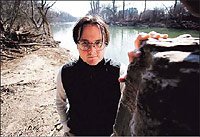
Kyle Minor has published fiction and nonfiction in such literary magazines as Quarterly West, Carolina Quarterly, Mid-American Review, Sou'wester, and River Teeth. His work has also been honored by Writer's Digest and the Atlantic Monthly—where he earned awards in all three genres of the student writing competition—honorable mention in fiction and poetry in 2005, and second place in nonfiction in 2004. He is editor of Frostproof Review and has taught at Ohio State, Antioch, and Capital universities, and the Gotham Writers Workshop. He earned an M.A. in Creative Writing (Fiction Writing) from Antioch, and will this spring complete an M.F.A. in Fiction and Nonfiction from Ohio State.
Most recently, Kyle's essay, "You Shall Go Out with Joy and Be Led Forth with Peace," a harrowing tale of the brutality of being bullied that also intelligently examines religious indoctrination, class, and race, was selected for inclusion in the Random House anthology Twentysomething Essays by Twentysomething Writers: The Best New Voices of 2006, edited by Matt Kellogg and Jillian Quint, and available in stores today, August 29th.

Kyle has kindly taken the time to sit down with me for a little virtual interview about writing in several genres, his writing plans for the future, and what it means to be anthologized.
* * *
CS: These kinds of "Best New Voices" anthologies are fairly common. Most of them I'm familiar with, however, showcase fiction, not essays. What do you make of this development?
KM: It seems that people these days are becoming more and more interested in literary nonfiction, especially the memoir. I hear it from my students all the time when I assign novels or short stories: "Why should we have to read this? It didn't really happen. It's not real!"
But that's not how I feel about it at all. Quite frankly, most of the memoir I read doesn't nearly begin to account for the sorry mess we can make of our lives the way good fiction can. Whenever I pick up, say, one of Philip Roth's Zuckerman novels, or Graham Greene's The Quiet American, or just about any of Andre Dubus's story collections, I feel like I'm communing with flesh and blood human beings. That's the same kind of transcendent experience I hope to offer my readers, whether they're reading my memoirs (which are, anyway, like fiction in the sense that they are a subjective rendering of things half-remembered, interpretations of memories of memories, because that's how our minds make sense of where and who we've been) or whether they're reading my fiction. I wish I could say that every story or essay I've published does this, but it's not true. I'm still learning, and it's hard as hell. I feel like I'm only starting to figure it out now, and I say that with fear and trembling.
CS: Since you do work rather extensively in both fiction and non-fiction, how do you go about deciding the best route toward attaining that transcendent experience? In other words, how do you decide whether material should be artfully rendered as fiction or non-fiction? Have the decisions become intuitive or do you experiment with the same material in both genres?
KM: I have experimented with the same material in both genres, and in poetry, too. In fact, there are poems that precede "You Shall Go Out with Joy and Be Led Forth with Peace" from which I've appropriated language and images (the starfruit tree, for example.) There are other poems, too, especially a series I wrote when I was taking a class with David Baker, that are themselves the germs of chapters of the book-length memoir.
The difference, with fiction, is that you have more liberty to transform the raw material, and also to imagine it through characters not yourself (though I suppose you use your own experience of yourself to inform the characterizations.)
Right now, for example, I'm working on a story that unfolds in the form of a sexual history. I wouldn't be afraid to address that material in the nonfiction, but I also fear it wouldn't be terribly interesting, since my own sexual history isn't terribly interesting to anyone except me. But to graft the things you know from your own life experience onto a character who finds himself or herself in an interesting predicament -- well, that's where, in fiction, the magic can happen.
In nonfiction, I don't find it terribly difficult to implicate myself or a character not unlike myself, but to try to get at the darknesses lurking inside characters unlike myself (or both like and not like myself, as these things tend to go), fiction seems like the best route.
Lately I've found that I'm reserving the most explosive events from my past for the nonfiction, and using the fiction to try to imagine my way through experiences I've seen or participated in, but through the eyes of some other involved person -- the mother, the sister, the victim, the perpetrator. But that's not always my working method. I'm not sure I even have a working method, except whatever's working at the moment.
CS: I like the distinction you make in the last paragraph. And it's true, "working methods," if they exist, tend to be a little elusive when it comes to writing.
Since you mentioned "You Shall Go Out with Joy and Be Led Forth with Peace": The essay's title is taken from one of the borrowed Jewish songs young Minor sings at school, which "are faintly reminiscent of sad country songs," and which "really slay [Minor], because there is something earned about that joy; it has come from a place of great pain." By the end of the essay, when Minor speaks at his friend Tony's funeral, he hasn't earned the kind of "joy-from-sadness" espoused by the song, but I couldn't help but think that perhaps the writer Minor, while rendering an artful interpretation of these events, might have earned some of that joy.
KM: I did a reading last spring at Ohio State, and it was terribly hard to get through it, and afterward people were coming up to me and saying the same kind of thing you're saying. It speaks, I think, to one of the fundamental illusions that I (and everyone else, it seems) have been under about the process of writing, that it would be somehow therapeutic.
It's true that I'm proud of that essay. It's helped to put me on the map after years and years of trying. But writing it required me to immerse myself in the interior landscape of the worst part of my childhood for an extended period of time. For months afterward I was having nightmares, and the night after I read it publicly for the first time, I couldn't sleep, and spent the next day walking and walking. The whole book would probably be finished by now, except that I had to put it aside for awhile to get my head straight.
There's something rather selfish about allowing oneself to spiral down into that kind of darkness for the sake of a piece of writing when other people are depending upon you. I know that during the time I was working on "You Shall Go Out with Joy," I was significantly less available to my wife and my son, and not just in terms of time, but also in terms of emotional availability. Somehow, to write as honestly as I wanted to write, I had to become twelve years old again, and strip away perfectly good defense mechanisms so I could revisit pain that I'd buried long ago.
I spent the first five years of my writing life making pretty things out of language. Lee Abbott was always hectoring me about this, but indirectly, by way of pithy sayings I didn't understand: It ought to cost you more than time to get it on the page. That kind of thing. I'm not that smart lots of the time, and for me it took somebody, in this case Michelle Herman, getting in my face and saying, "I don't buy these stories you're writing. What is it you really want to be writing about?" for me to remember what it was that made me want to be a writer in the first place. Even then, I didn't realize what it would cost me to confront my own darkest places until I actually did it. I'm still not sure it's worth it.
If you think about the writers I love who have done this over and over -- Andre Dubus, Graham Greene (who wrote potboilers, sure, but who also wrote very personal books like The Power and the Glory and The End of the Affair), Raymond Carver, Alice Munro -- and you look at their own personal histories and see the way they were often writing so close to the bone, you have to wonder how they were able to sustain it for as long as they did. It had to take a real toll on them personally, and certainly on their families, too. When I think about that, it scares me to death, because I feel like I've crossed some sort of line in the sand -- I don't really want to go back to making pretty things for the sake of making pretty things -- and yet I don't want to live my life only in service of the writing, either, which is the real temptation. It's a tightrope.
CS: It is a tightrope. Some instructors and I were talking to a group of undergraduate seniors in creative writing this past term about "writing in the real world," and one of my colleagues said something very heartfelt about how his commitment to the art trumps pretty much everything, and how he has sacrificed numerous things in his personal life in order to achieve what he's wanted to with his writing. As a twenty-two-year-old, I probably would have rallied behind such a sentiment, but when it came my turn to talk, I offered a different point of view, explaining the reason why I tend to write either very early in the morning or very late at night--because I don't want it to interfere with the rest of my life on a daily basis. I explained that I want to be available to people--not just with my time but with that emotional availability you're talking about. I argued, too, that the external "rewards" of writing--publication, readers--is never going to amount to much in the grand scheme of things. Afterwards, it occurred to me that I hadn't truly had much of the kind of "success" I was somewhat eschewing. You, though, are now officially anthologized, yet you still question whether or not the personal sacrifices are worth it?
KM: I don't really know how to answer the question. From a worldly perspective, the anthology hasn't made me successful at all. I'm still scrapping, still grinding out a massive adjunct teaching load at four schools, still staying up late or getting up early to find time to read and write, still living in an ancient brick apartment, still unable to provide many of the things I'd like to provide for my family. Every once in awhile something comes along -- I have a friend, for example, who works at a mortgage repossession and reselling company. They need someone with a writing background to grind out case studies and other kinds of business documents. It would have paid something like $70,000 a year to start, with built-in escalators every six months. Needless to say, that's a lot more money than I'm making now. The main reason I'm not interested is that I know it would sap all my writing energy and wall me off from the material I care about. There's a sense in which that sounds terribly noble, the decision to not pursue those kinds of opportunities for the sake of art, but there's also a sense in which it is terribly selfish. Because I know that I could buy my wife a house and put money away for retirement and maybe help out family members who need it, and, hell, all kinds of other good things. I have a friend who’s trying to alleviate poverty in Haiti. I could help him. But I won't do it, and all because I want the time and space and mental energy to devote myself to writing that will likely never find a large audience, and whose driving impulse is mainly personal, and therefore, I suppose, selfish. With all that, though, I still feel like it's worth it, so long as I can make time for my family and be good and loving to them and make sure that they have a roof over their heads and food to eat.
CS: Speaking of the time and space and mental energy you devote to writing, what is your writing schedule like? Also, how do you go about deciding on any given day whether you're going to work on a short story, or your memoir, or a poem? Is working in multiple genres a boon or hindrance?
KM: It changes all the time. Right now, for example, I'm supposed to be working on revising the novel and the book-length memoir, but I'm procrastinating by working, off-and-on, on a novella, mostly. But on Sunday I got all excited about a new short story and stayed up all night Sunday, Monday, and Tuesday nights, sleeping about four hours in the early morning. That's a working method I favor but hardly get to do anymore, because of teaching, but it was the lucky week off between the end of Ohio State's summer quarter and the beginning of Capital's fall semester. By Wednesday at 6 pm, I had a 10,500 word first draft that was, quite frankly, a lot more finished than the fourth draft of the novella that's open in the Microsoft Word window right next door. And now I'm tired, and don't have the energy to get back to prose, and probably won't until the weekend, so I'll spend a couple of hours the next few days revising some poems.
I was talking to a friend about this the other day, and he was saying that he didn't have space in his head for more than one story at a time, that the writing of one demanded his complete and sustained attention. I find that my complete and sustained attention to something that isn't working just gives me a headache and causes me to force pages that I later end up cutting anyway. But getting away from a problem for awhile seems to give my unconscious the space it needs to find the solution. The solution usually comes when I'm in the shower, thinking about something else, or while reading a book by a writer who is my polar opposite in language and temperament, or while taking a long walk down Neil Avenue, from 17th to 3rd, and back again.
CS: Once finished drafts of these manuscripts accrue, how do you go about submitting them for publication? Has editing Frostproof Review taught you anything about the process?
KM: That the process is brutal, sure, but also that the cream rises quickly to the top. The best thing I ever had the honor to publish (which is saying an awful lot, when one considers the company it's keeping in the pages of the Frostproof Review) is a novella by Jennifer Spiegel titled "Goodbye, Madagascar." It arrived packaged with a smart cover letter, but who cares? The first sentence made me want to read the second, and the second the third, and in forty-five minutes, I'd read that seventy page story. And then I read it again. And then I called her on the phone in Arizona late at night and said, "I hope nobody else has taken this, because it's the most beautiful thing I've read in a long time."
I don't get fancy with my submissions anymore. I send a three sentence cover letter: Here's my story, here's where I've previously published, thanks for taking the time to read it. Everyone thinks there's a magical formula, but all the editors really care about is whether or not the story or poem or essay knocked them flat, and if it didn't, it probably isn't ready to be published, anyway. They're doing you a favor by rejecting you. At least, that's how I think about it.
CS: Besides showcasing non-fiction in lieu of fiction, something else that interested me about the Twentysomething anthology was the fact that they solicited manuscripts for inclusion in the anthology from the general public, rather than from writing programs and/or literary magazines. How did you find out about the anthology, and how did you choose what to submit to them? What kind of effect do you think their "open" submission policy had on the anthology?
KM: I think it made possible the discovery of a lot of new writers. The very nature of the selection process of ordinary anthologies tends to privelege work from established writers and work that was originally published in the more prestigious journals. The sheer workload involved in screening makes that a practical reality. If a story begins slowly, but it's written by Alice Munro or William Trevor, or it was originally published in the Georgia Review or Ploughshares, the odds are still pretty good that the story will reward the time required to read it. But, as I know from editing even a small literary journal, one might not extend the same generosity to an unpublished writer from nowhere familiar. It's not a big conspiracy; it's just a matter of time. There are only so many hours in the day, and if something doesn't seem immediately promising, it's not going to get the same kind of attention as something that holds promise for one reason or another.
The Twentysomething Essays anthology took most of that out of the equation, because everyone was unknown, and all the essays were unpublished at the time of submission. And the results speak for themselves. There are essays in that volume, like Jennifer Glaser's "Sex and the Sickbed," or Mary Beth Ellis's "The Waltz," or Joey Franklin's "Working at Wendy's," that I, at least, can't stop thinking about. Random House was smart enough to cast a wide net and find them, and now, if they're much like me, they'll be inclined to want to dance with the one who brung 'em when it's time to talk book deal.
CS: On the subject of book deals: You mentioned that you're in the process of revising a novel and the memoir. Where are you at in the revision process? When do you think we'll see "You Shall Go Out with Joy and Be Led Forth with Peace" in between the covers of a book filled with only Kyle Minor's writing?
KM: For both the novel and the memoir, I have all these pages I keep taking out and putting back in, and it's not anything like the proverbial taking-out and putting-in of commas that means the thing is done. It's more like I've not yet really got a handle on the shape of either thing, and I'm not ready, yet, to even send them to my trusted first readers.
The memoir, I suspect, will be done first. My friend Don Pollock has already taken me to task for not having it done already, and with good reason: I have this nice first-look arrangement with Random House, and the thought that I'd wait too long and blow my chances at placing it with one of the best publishing houses in the world (not to mention the chance to work again with Matt Kellogg, who is as fine an editor as I've ever met), quite frankly scares me almost as much as the prospect of finishing it and sending it out into the world.
But the truth is I've been spending most of the summer writing a novella and some short stories. I don't want to send either one out into the world until they're ready, because I've already had the experience of being haunted by early publication of work that didn't yet know what it wanted to be. I think with a first book, when one considers how few chances you actually have to publish a book in an entire lifetime, that caution ought to be the order of the day. With the novel, especially, I plan to take my good sweet time.
In my secret, greedy heart, though, I daydream about winning one of the big short story collection contests, like the Flannery O'Connor or the Drue Heinz, and seeing simultaneous publication of the fiction and the nonfiction books. Three years at Ohio State, though, in a community of writers so extraordinary, has made me really reevaluate what kind of book I would want to send out. There are four first-class writers of short fiction (Lee Abbott, Michelle Herman, Lee Martin, and Erin McGraw) on the faculty, and you can't help picking up one of their books now and again, and reading some stories, and realizing exactly how excellent and well-crafted and moving a story has to be before it's worth collecting. And then your classmates in workshop are Donald Ray Pollock or Holly Goddard Jones, and both of them writing and publishing stories as good as anything in your Norton anthology; and then there's recent graduate Christopher Coake's collection We're in Trouble, which is maybe the best short story collection published in America in the last five years. Those writers have become a sort of benchmark for me, because I guess I'm a person who needs benchmarks. I don't want to publish a book of stories until I know I've written one that could sit proudly on the shelf alongside theirs, and that's no small feat. Maybe when I'm fifty.
CS: I’m with you on caution being the order of the day, but fifty? That might push you toward an entirely different anthology.
KM: Sometimes I wonder if it might not be more useful for readers if publishers and book reviewers reserved all the energy and attention they like to lavish upon hot young writers, and bestowed it, instead, on writers over fifty, sixty, seventy, who have so much more lived life to write about. It used to be that the great writers (Hemingway, Faulkner, Fitzgerald, that generation) wrote their great books as young men (and wasn’t it always men, back then, who were considered the great writers?) But now, and maybe because writers are eating better and working out more and drinking less, it seems that our better writers are doing their best work in their waning years. I’m thinking about Roth’s American trilogy, and Marilynne Robinson’s Gilead, and the Peter Taylor of The Old Forest, and the William Maxwell of So Long, See You Tomorrow. And then there’s Annie Proulx, who didn’t even start publishing fiction until she was well into her fifties. Or, closer to home, Lee K. Abbott’s recent experiments with a more public kind of story, such as “One of Star Wars, One of Doom,” which, now that five years have passed and we are getting access to documents left behind by the killers for the first time, is turning out to be more right about the perpetrators of the Columbine incident than the journalism that was being written at the same time. They weren’t monsters; they were real flesh and blood human beings with petty grievances not terribly unlike our own: They wanted girls to like them. And that whole affair is strangely reminiscent of the circumstances surrounding the publication of Eudora Welty’s final (and possibly finest) story “Where is the Voice Coming From?” which so accurately (and eerily) predicted the person, circumstances, and mindset of Medgar Evers’s killer that, when the man was finally arrested, she was forced to change some of the details in her story in the interest of not unduly influencing the prosecution.
So, yes, I’d welcome the chance to be in such an anthology in twenty or thirty years or so. Fiftysomething Stories by Fiftysomething Writers? Sixty by Sixty? Can you imagine how thrilling it would be to keep company like that?
8.26.2006
All That Being Said...
A film will most likely soon be made of Winter’s Bone, and I want to play the casting game.
Ree Dolly--Natalie Portman (though Jena Malone would probably be a good fit, and if Lindsay Lohan could do drama, she would have the look for the part).
Gail--Taryn Manning (Runners-Up: Mischa Barton, if she could pull off the Ozarks accent, which I doubt she could, and Amy Adams, who would probably be great but may be a little too old for the role).
Mom--Debra Winger
Uncle Teardrop--Ed Harris
Director--Ang Lee, though he didn't do such a great job adapting one of Woodrell's earlier novels. Other possibilities: Sam Mendes, John Boorman.
If you’ve read the book and have suggestions for casting, feel free to leave them in the comments section. If you haven't read it, go pick up a copy, and then come back and play along.
Ree Dolly--Natalie Portman (though Jena Malone would probably be a good fit, and if Lindsay Lohan could do drama, she would have the look for the part).
Gail--Taryn Manning (Runners-Up: Mischa Barton, if she could pull off the Ozarks accent, which I doubt she could, and Amy Adams, who would probably be great but may be a little too old for the role).
Mom--Debra Winger
Uncle Teardrop--Ed Harris
Director--Ang Lee, though he didn't do such a great job adapting one of Woodrell's earlier novels. Other possibilities: Sam Mendes, John Boorman.
If you’ve read the book and have suggestions for casting, feel free to leave them in the comments section. If you haven't read it, go pick up a copy, and then come back and play along.
The High and Low of It
Culture, that is.
I didn’t mention that before the Working Girl and I ventured out to the New Windsor Rodeo Saturday night we watched a matinee of Snakes on a Plane.
Now, I’m always a little late to the game. My Internet browsing consists mostly of visiting a few blogs, a few literary websites, and checking my four or five email accounts. So I didn’t see the Snakes on a Plane trailer until about two weeks ago, and I saw it on television, not the Internet. W.G. was in another room, and she heard me saying out loud to myself, “What the hell?”
I told her what I’d just seen—a bunch of snakes, on a plane. She said, “That’s the first you’ve heard of it?”
It was. And, as I said, my first reaction was mostly astonishment. Ten years or so ago, amid the tirade of movies that featured natural disasters in lieu of plot or characters—there were, if I remember correctly—volcanoes, tornadoes, floods, earthquakes—I used to try and come up with a joke about what the next installment would showcase—A blizzard? Really big rain puddles? A strong wind?—but pretty much anything I could come up with was out there already, or in production, and thus my jokes tended to fall flat.
This, though, this Snakes on a Plane, had to take the proverbial cake as the ultimate in ridiculous plots.
So, bored and looking for a movie to watch Saturday afternoon, W.G. and I decided to check it out.
The result: I don’t think I’ve ever laughed as frequently or as hard in a movie theater as I did that afternoon. Even W.G., prone as she is to silent laughter—the kind that takes place mostly in her head—let a few laughs rip.
The movie is truly over-the-top. I don’t think I’m spoiling anything by saying that in the movie’s first half hour, three people die in the airplane’s bathrooms, and one woman is, um, “seduced” by one of the creatures.
But I was never, throughout the movie’s entire 90 minutes, not entertained.
Does the film invite further study? Will I ever watch it again? No and probably not, though I can imagine this thing being shown in theatres, a la The Rocky Horror Picture Show, for years.
* * *
This is the wonderful writer Gary Lutz, in an interview:
“When I'm in the mood for a story, when I feel like knowing who did what to whom, I'll watch Ghost World for the 40th time or some other wonderful movie. Movies are the perfect storytelling medium.”
Now, I don’t think Snakes on a Plane is anywhere near perfect storytelling, and it’s definitely no Ghost World. The movie does take causality into account, though. We know why and how the snakes get on the plane, and why they’re so vicious. And there’s something like character development, though I think most of it is tongue-in-cheek, or at least that’s the way I took it, and in doing so found it hilarious.
But I bring up Lutz’ quote for another reason. I’ve mentioned on this blog a few times that in my early days as a writer I cared solely about language and paid little to no attention to plot, causality, even character.
In graduate school, however, “story” became a more primary concern for me as a writer. I read my first detective novel (which was, in fact, my first ever foray into reading genre). I paid attention to plot and character development, and not just in the books I was reading. I also watched films differently. And I became obsessed with good television shows like The Sopranos and Six Feet Under.
After studying “story” for a few years, I think I would have agreed with Lutz—films are perhaps better suited for conveying story than fiction.
I found that, though I could get into the “story” of a novel, if its language were not working in a way that kept me interested, I was less inclined to want to keep reading.
Here is another quote from Lutz, from the same interview: “I don't read fiction for the story; I read it for the acts of language, for the feelingful feats of syntax, and if I don't find any, I'll move on.”
While I was studying “story” I came across a few books whose authors managed to both tell a riveting story and do so using language that satisfied me: The Corrections by Jonathan Franzen, the Judas novels of Will Christopher Baer, the works of Dennis LeHane, and Daniel Woodrell’s Tomato Red.
I should say that I still enjoyed reading “literary” fiction as much as anything. And I agree with what Ben Marcus had to say in Harper’s about language-based writing: it’s good for the brain. But reading some of the above authors made me re-evaluate whether or not the two—strong language and strong story—needed to be exclusive, because when I encountered writers with a feel for language that was indeed “literary,” but who could also make me really want to turn the book’s pages—not just languor in the sentences—I was hooked. And for me, this kind of writing is generally my favorite of all “entertainment” experiences.
* * *
I mentioned, among those books I considered exceptional (and there were many more, but those works come to mind quickly) Tomato Red, a novel by Daniel Woodrell.
Here’s half the first sentence of that novel: “You’re no angel, you know how this stuff comes to happen: Friday is payday and it’s been a gray day sogged by a slow ugly rain and you seek company in your gloom, and since you’re fresh to West Table, Mo., and a new hand at the dog-food factory, your choices for company are narrow but you find some finally in a trailer court on East Main, and the coed circle of bums gathered there spot you a beer, then a jug of tequila starts to rotate and the rain keeps comin’ down with a miserable bluesy beat and there’s two girls millin’ about that probably can be had but they seem to like certain things and crank is one of those certain things, and a fistful of party straws tumble from a woven handbag somebody brung, the crank gets cut into lines…”
That’s right, half the first sentence. (And just so you know, the novel quickly becomes first-person, for those of you put-off by the use of second-person.)
The language is fairly stellar, but so, too, is the book’s plot. Its characters are well developed, if odd, and they are thrown into some interesting and compelling circumstances.
I just this week (yes, the same week I watched Snakes on a Plane) read Woodrell’s latest: Winter’s Bone. And the language in this one is even better than the language in Tomato Red in my opinion. So, too, is the story.
The story is an old one: a girl goes in search of her missing father.
She encounters problems along the way that border on the melodramatic, but what bolsters her search is the language in which the novel is written. And it is here, I think, that Woodrell succeeds in achieving that rare combination: He’s written a book with an honest-to-God story but done so in a way that allows the reader to still marvel at his “acts of language.”
Does the novel invite further study? Will I ever read it again? Yes and most definitely yes. I may read it again later today (because I still don’t quite get the thing about the names).
So, for those of you who’ve scrolled this far down the page: go and check this guy out. He’ll definitely make it worth your time. And once you’re done with Winter’s Bone, and you’re feeling a little down about Ree Dolly’s circumstances, and the overall condition of the world, go and check out Snakes on a Plane. It is guaranteed to lighten your mood pretty quickly.
I didn’t mention that before the Working Girl and I ventured out to the New Windsor Rodeo Saturday night we watched a matinee of Snakes on a Plane.
Now, I’m always a little late to the game. My Internet browsing consists mostly of visiting a few blogs, a few literary websites, and checking my four or five email accounts. So I didn’t see the Snakes on a Plane trailer until about two weeks ago, and I saw it on television, not the Internet. W.G. was in another room, and she heard me saying out loud to myself, “What the hell?”
I told her what I’d just seen—a bunch of snakes, on a plane. She said, “That’s the first you’ve heard of it?”
It was. And, as I said, my first reaction was mostly astonishment. Ten years or so ago, amid the tirade of movies that featured natural disasters in lieu of plot or characters—there were, if I remember correctly—volcanoes, tornadoes, floods, earthquakes—I used to try and come up with a joke about what the next installment would showcase—A blizzard? Really big rain puddles? A strong wind?—but pretty much anything I could come up with was out there already, or in production, and thus my jokes tended to fall flat.
This, though, this Snakes on a Plane, had to take the proverbial cake as the ultimate in ridiculous plots.
So, bored and looking for a movie to watch Saturday afternoon, W.G. and I decided to check it out.
The result: I don’t think I’ve ever laughed as frequently or as hard in a movie theater as I did that afternoon. Even W.G., prone as she is to silent laughter—the kind that takes place mostly in her head—let a few laughs rip.
The movie is truly over-the-top. I don’t think I’m spoiling anything by saying that in the movie’s first half hour, three people die in the airplane’s bathrooms, and one woman is, um, “seduced” by one of the creatures.
But I was never, throughout the movie’s entire 90 minutes, not entertained.
Does the film invite further study? Will I ever watch it again? No and probably not, though I can imagine this thing being shown in theatres, a la The Rocky Horror Picture Show, for years.
* * *
This is the wonderful writer Gary Lutz, in an interview:
“When I'm in the mood for a story, when I feel like knowing who did what to whom, I'll watch Ghost World for the 40th time or some other wonderful movie. Movies are the perfect storytelling medium.”
Now, I don’t think Snakes on a Plane is anywhere near perfect storytelling, and it’s definitely no Ghost World. The movie does take causality into account, though. We know why and how the snakes get on the plane, and why they’re so vicious. And there’s something like character development, though I think most of it is tongue-in-cheek, or at least that’s the way I took it, and in doing so found it hilarious.
But I bring up Lutz’ quote for another reason. I’ve mentioned on this blog a few times that in my early days as a writer I cared solely about language and paid little to no attention to plot, causality, even character.
In graduate school, however, “story” became a more primary concern for me as a writer. I read my first detective novel (which was, in fact, my first ever foray into reading genre). I paid attention to plot and character development, and not just in the books I was reading. I also watched films differently. And I became obsessed with good television shows like The Sopranos and Six Feet Under.
After studying “story” for a few years, I think I would have agreed with Lutz—films are perhaps better suited for conveying story than fiction.
I found that, though I could get into the “story” of a novel, if its language were not working in a way that kept me interested, I was less inclined to want to keep reading.
Here is another quote from Lutz, from the same interview: “I don't read fiction for the story; I read it for the acts of language, for the feelingful feats of syntax, and if I don't find any, I'll move on.”
While I was studying “story” I came across a few books whose authors managed to both tell a riveting story and do so using language that satisfied me: The Corrections by Jonathan Franzen, the Judas novels of Will Christopher Baer, the works of Dennis LeHane, and Daniel Woodrell’s Tomato Red.
I should say that I still enjoyed reading “literary” fiction as much as anything. And I agree with what Ben Marcus had to say in Harper’s about language-based writing: it’s good for the brain. But reading some of the above authors made me re-evaluate whether or not the two—strong language and strong story—needed to be exclusive, because when I encountered writers with a feel for language that was indeed “literary,” but who could also make me really want to turn the book’s pages—not just languor in the sentences—I was hooked. And for me, this kind of writing is generally my favorite of all “entertainment” experiences.
* * *
I mentioned, among those books I considered exceptional (and there were many more, but those works come to mind quickly) Tomato Red, a novel by Daniel Woodrell.
Here’s half the first sentence of that novel: “You’re no angel, you know how this stuff comes to happen: Friday is payday and it’s been a gray day sogged by a slow ugly rain and you seek company in your gloom, and since you’re fresh to West Table, Mo., and a new hand at the dog-food factory, your choices for company are narrow but you find some finally in a trailer court on East Main, and the coed circle of bums gathered there spot you a beer, then a jug of tequila starts to rotate and the rain keeps comin’ down with a miserable bluesy beat and there’s two girls millin’ about that probably can be had but they seem to like certain things and crank is one of those certain things, and a fistful of party straws tumble from a woven handbag somebody brung, the crank gets cut into lines…”
That’s right, half the first sentence. (And just so you know, the novel quickly becomes first-person, for those of you put-off by the use of second-person.)
The language is fairly stellar, but so, too, is the book’s plot. Its characters are well developed, if odd, and they are thrown into some interesting and compelling circumstances.
I just this week (yes, the same week I watched Snakes on a Plane) read Woodrell’s latest: Winter’s Bone. And the language in this one is even better than the language in Tomato Red in my opinion. So, too, is the story.
The story is an old one: a girl goes in search of her missing father.
She encounters problems along the way that border on the melodramatic, but what bolsters her search is the language in which the novel is written. And it is here, I think, that Woodrell succeeds in achieving that rare combination: He’s written a book with an honest-to-God story but done so in a way that allows the reader to still marvel at his “acts of language.”
Does the novel invite further study? Will I ever read it again? Yes and most definitely yes. I may read it again later today (because I still don’t quite get the thing about the names).
So, for those of you who’ve scrolled this far down the page: go and check this guy out. He’ll definitely make it worth your time. And once you’re done with Winter’s Bone, and you’re feeling a little down about Ree Dolly’s circumstances, and the overall condition of the world, go and check out Snakes on a Plane. It is guaranteed to lighten your mood pretty quickly.
8.24.2006
Poetry Thursday--Time
The theme over at Poetry Thursday this week: Time.
What follows is more a fragment than anything.
When we bury my grandfather
the cemetery’s silk flowers sing
like huddled children, half-frozen.
They chatter. Our shoes, rimed
with street-salt, unintentionally,
mournfully, crush winter's invisible roses.
*I believe the notion of "invisible roses" came from a poem by Michael Palmer.
What follows is more a fragment than anything.
When we bury my grandfather
the cemetery’s silk flowers sing
like huddled children, half-frozen.
They chatter. Our shoes, rimed
with street-salt, unintentionally,
mournfully, crush winter's invisible roses.
*I believe the notion of "invisible roses" came from a poem by Michael Palmer.
8.22.2006
I Let My Faith Wane
and then yesterday the Galesburg Public Library surprised me, when I found on the new fiction shelf:
Daniel Woodrell's Winter's Bone
&
Scott Snyder's Voodoo Heart
One thing about the Galesburg Public Library I love: They still stamp the insides of books, to let you know when they're due. I used to love being able to see how many people had checked out a certain book, and when they'd checked it out, almost as much as I love reading other people's marginalia. Recently, though, many libraries have thrown away their stamps, and made checking out books a wholly electronic process, which is a shame.
In case you were wondering, I was the first person to check out either of the above books.
Daniel Woodrell's Winter's Bone
&
Scott Snyder's Voodoo Heart
One thing about the Galesburg Public Library I love: They still stamp the insides of books, to let you know when they're due. I used to love being able to see how many people had checked out a certain book, and when they'd checked it out, almost as much as I love reading other people's marginalia. Recently, though, many libraries have thrown away their stamps, and made checking out books a wholly electronic process, which is a shame.
In case you were wondering, I was the first person to check out either of the above books.
8.20.2006
The New Windsor Fair, Rodeo, and Horse Show
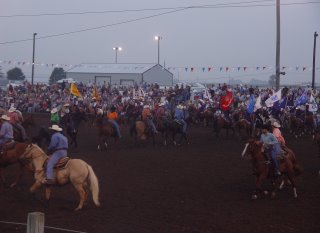
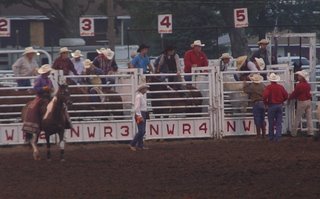
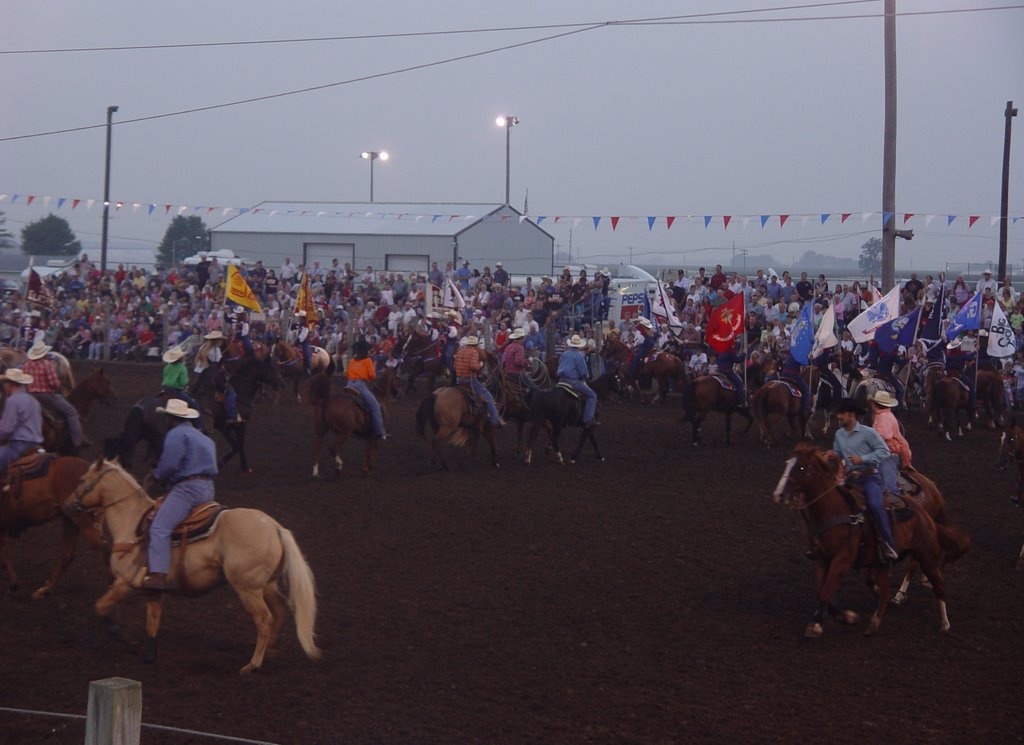
Last night we journeyed over to the New Windsor Fair, Rodeo, and Horse Show--justifiably dubbed "The Best Little Rodeo in the Midwest." I say justifiably, but the truth is, it's the only rodeo I've ever been to--in the Midwest or otherwise.
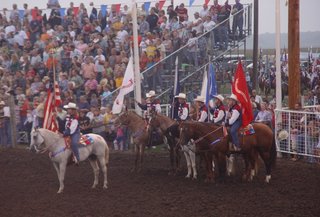
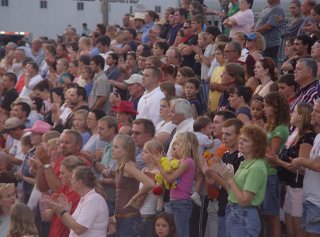
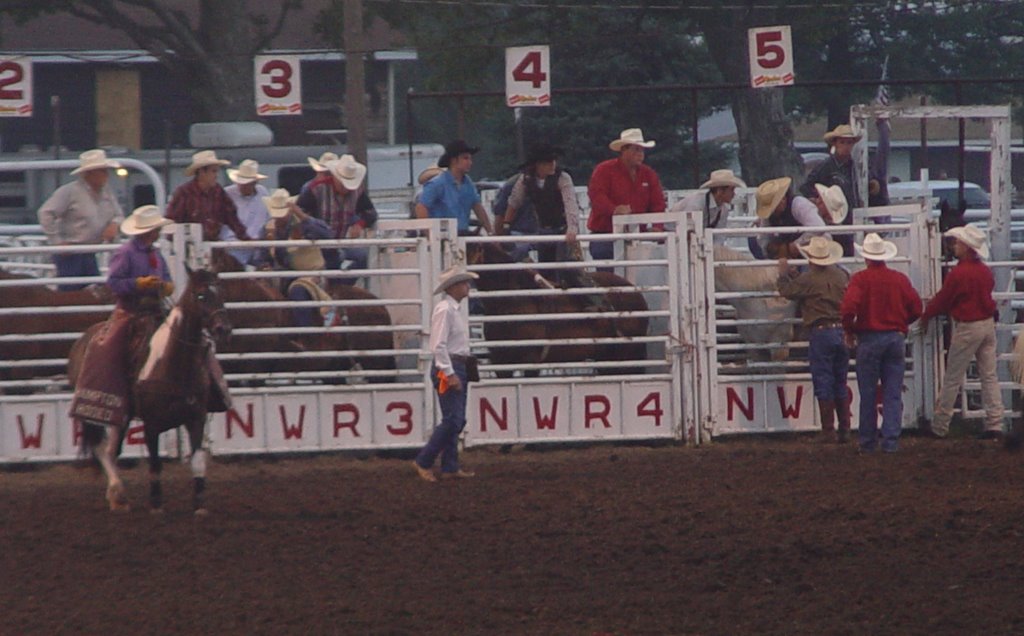
I'll let some photos say their thousand words and whatnot:
Before the show
The pomp
The crowd
More pomp
Preparing for action
Um...action
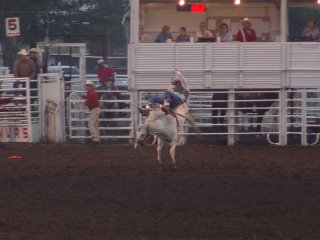
More action (No calves were injured in the making of this photograph)
I didn't get any photos of this act but probably should have.
And tangentially related, for the people who show up here because they like books: Check out Maile Meloy's "Ranch Girl."
Come on. Go do it. You'll be glad you did.
I'll let some photos say their thousand words and whatnot:
Before the show
The pomp

The crowd

More pomp
Preparing for action
Um...action
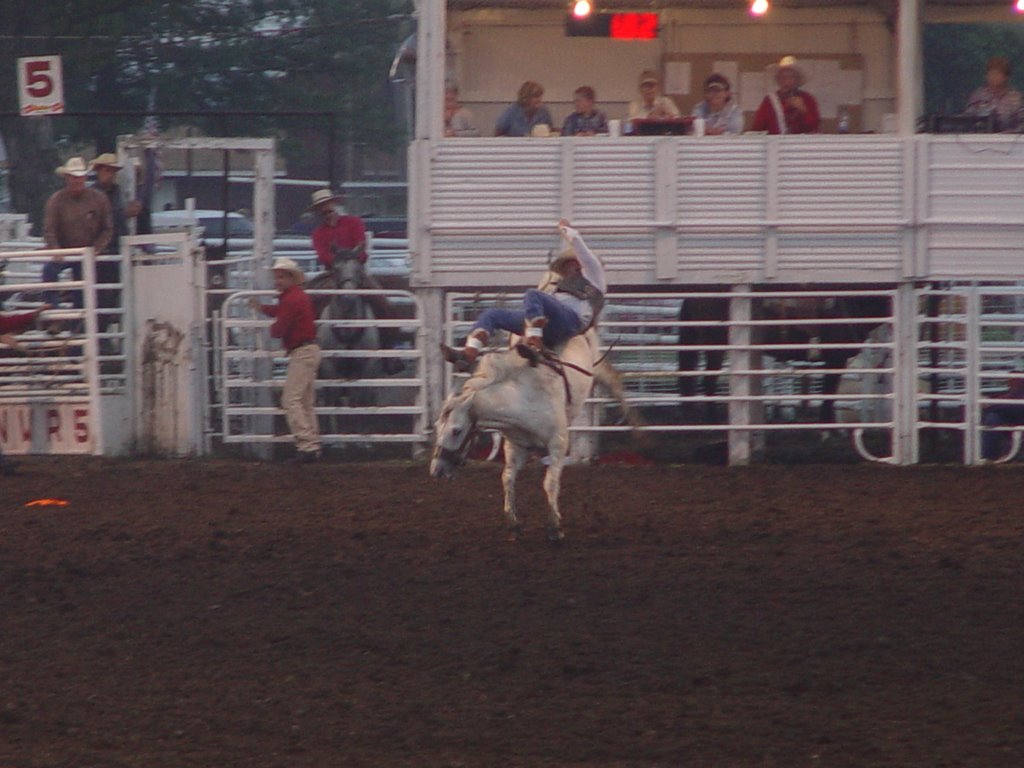
More action (No calves were injured in the making of this photograph)
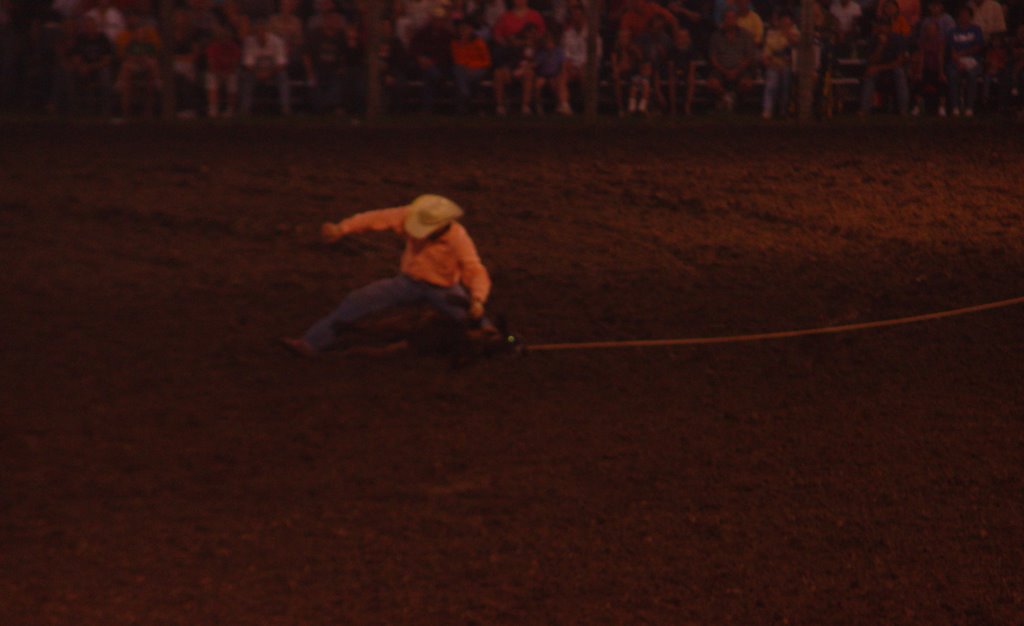
I didn't get any photos of this act but probably should have.
And tangentially related, for the people who show up here because they like books: Check out Maile Meloy's "Ranch Girl."
Come on. Go do it. You'll be glad you did.
Fishing with D. Redux
I didn't take a camera this time, so I'm going to have to rely on words for highlights of my two days at the lake with D.:
About forty-five minutes after we arrived I was still putting away groceries and getting the cabin situated. D., though, had my mom's wire cage staked to the slope leading down to the lake, and the cage was in the water, already filled with baby bluegill and sunfish. When I walked outside, he pulled the cage out of the water. "Look," he said.
Fifteen fish lay on their sides, glistening dully in the setting sun, not even bothering to writhe or flop.
"If the lake people catch you keeping babies," I lied, "they'll make us leave."
"But they're stupid," D. said. He put the cage back in the water and held up a piece of fishing line with a gold hook tied to it. "I'm not even using bait."
"Just because they're stupid baby fish doesn't mean they deserve to die," I said.
"But, Chad," D. said, pleading. "They're really stupid."
Ten minutes later I was lakeside, and I pulled the cage out of the water, to check on the fish. It was empty.
* * *
D. had actually wanted to use the baby bluegill and sunfish as bait for catfish. He wanted to cut up the fish into pieces and spear them on his hooks. I convinced him to use stink bait instead, and he set two catfish lines just before dark.
Then we played some PS2 and watched "The Benchwarmers." Before he fell asleep, D. asked, "Should we go check the catfish lines?"
I convinced him to wait it out till morning, that the longer the lines were in the water, the better chance we'd have of finding a fish on them. After D. fell asleep, I thought a stupid but heartfelt little prayer to myself, Let the kid catch a catfish. Please. Just one catfish.
"Chad," D said, shaking me awake at ten after six the next morning. "The catfish lines."
"All right," I said. "Let's go check 'em out."
While we walked down the hill to the lake, I was thinking the same little prayer again: Let there be a catfish on the line. Just one crummy catfish.
D., barefooted, wearing only a pair of shorts, beat me down to the water. "Get the net," he yelled. "Hurry!"
I brought the net over to the dock, and found a catfish rolling over in the water, showing us his white belly.
A few minutes later, we had the four-pound fish out of the water, and unhooked, and delivered to the wire cage D. still had staked to the slope in the hill.
* * *
D. set catfish lines for the rest of the day--four of them at a time--and managed to pull a one-pounder out of the water at about noon.
He had stink bait on his hands, in his hair, all over his shorts.
My truck's cab still smells like the stuff.
It is not, oddly, a totally unpleasant stink.
About forty-five minutes after we arrived I was still putting away groceries and getting the cabin situated. D., though, had my mom's wire cage staked to the slope leading down to the lake, and the cage was in the water, already filled with baby bluegill and sunfish. When I walked outside, he pulled the cage out of the water. "Look," he said.
Fifteen fish lay on their sides, glistening dully in the setting sun, not even bothering to writhe or flop.
"If the lake people catch you keeping babies," I lied, "they'll make us leave."
"But they're stupid," D. said. He put the cage back in the water and held up a piece of fishing line with a gold hook tied to it. "I'm not even using bait."
"Just because they're stupid baby fish doesn't mean they deserve to die," I said.
"But, Chad," D. said, pleading. "They're really stupid."
Ten minutes later I was lakeside, and I pulled the cage out of the water, to check on the fish. It was empty.
* * *
D. had actually wanted to use the baby bluegill and sunfish as bait for catfish. He wanted to cut up the fish into pieces and spear them on his hooks. I convinced him to use stink bait instead, and he set two catfish lines just before dark.
Then we played some PS2 and watched "The Benchwarmers." Before he fell asleep, D. asked, "Should we go check the catfish lines?"
I convinced him to wait it out till morning, that the longer the lines were in the water, the better chance we'd have of finding a fish on them. After D. fell asleep, I thought a stupid but heartfelt little prayer to myself, Let the kid catch a catfish. Please. Just one catfish.
"Chad," D said, shaking me awake at ten after six the next morning. "The catfish lines."
"All right," I said. "Let's go check 'em out."
While we walked down the hill to the lake, I was thinking the same little prayer again: Let there be a catfish on the line. Just one crummy catfish.
D., barefooted, wearing only a pair of shorts, beat me down to the water. "Get the net," he yelled. "Hurry!"
I brought the net over to the dock, and found a catfish rolling over in the water, showing us his white belly.
A few minutes later, we had the four-pound fish out of the water, and unhooked, and delivered to the wire cage D. still had staked to the slope in the hill.
* * *
D. set catfish lines for the rest of the day--four of them at a time--and managed to pull a one-pounder out of the water at about noon.
He had stink bait on his hands, in his hair, all over his shorts.
My truck's cab still smells like the stuff.
It is not, oddly, a totally unpleasant stink.
8.19.2006
Reviewed Redux
A review of Versal 04 is up over at New Pages and includes a little write-up of my story "Hunger." Much thanks to Matt Bell for getting the word out about this very cool magazine. And if you haven't checked out Mr. Bell's website lately, head on over there. The Dancing on Fly Ash archives are up and running, and he has some links to pretty kick-ass stories of his that have appeared recently in rumble, Storyglossia, and McSweeney's.
8.16.2006
Poetry Th--ur, Wednesday
Since I'm off to the lake cabin this afternoon, I decided to play along with Poetry Thursday a day early. This week's theme: Whatever the Heck You Want. So: A poem by Richard Brautigan, taken from The Pill versus the Springhill Mine Disaster.
The Shenevertakesherwatchoff Poem
For Marcia
Because you always have a clock
strapped to your body, it's natural
that I should think of you as the
correct time:
with your long blonde hair at 8:03,
and your pulse-lightning breasts at
11:17, and your rose-meow smile at 5:30,
I know I'm right.
While looking for this poem, I came across another old favorite of mine. As far as poems go, it may be NSFW, but because I'm crazy like that, I'm posting it anyway.
I've Never Had It Done so Gently Before
For M
The sweet juices of your mouth
are like castles bathed in honey.
I've never had it done so gently before.
You have put a circle of castles
around my penis and you swirl them
like sunlight on the wings of birds.
The Shenevertakesherwatchoff Poem
For Marcia
Because you always have a clock
strapped to your body, it's natural
that I should think of you as the
correct time:
with your long blonde hair at 8:03,
and your pulse-lightning breasts at
11:17, and your rose-meow smile at 5:30,
I know I'm right.
While looking for this poem, I came across another old favorite of mine. As far as poems go, it may be NSFW, but because I'm crazy like that, I'm posting it anyway.
I've Never Had It Done so Gently Before
For M
The sweet juices of your mouth
are like castles bathed in honey.
I've never had it done so gently before.
You have put a circle of castles
around my penis and you swirl them
like sunlight on the wings of birds.
8.15.2006
Answers to Questions You Never Thought to Ask
“All I Have in the World” is the title of the story collection I’m working on.
I don’t intend for the title of the blog to imply that what I write here is all I have in the world, because, well, that would just be depressing.
* * *
I don’t always wear Elvis sunglasses. In fact, I don’t even own a pair of Elvis sunglasses (but Christmas is coming!) The picture in my avatar was taken at a chotchkee shop in Vegas, the day after my wife and I were married. We were married at the Graceland Wedding Chapel, but Elvis didn’t conduct the ceremony because, we thought, that would be a little cheesy.
Elvis was, however, in the building. He was talking to the woman who signed our marriage certificate. They were married, or dating, or something.
* * *
I do have a job. It resumes three weeks from Thursday, and I’m actually kind of looking forward to it.
* * *
I’m taking D. fishing again tomorrow. I’m picking him up at 5:00, and we’re going to spend the night at the cabin, where we’ll fish, play games on my mom’s PS2, and eat lots of junk food. I’ll return him to his rightful owner on Thursday.
* * *
Um, probably sushi. It’s a rare find around here but tends to be worth the drive—however long it takes us to get there and back.
* * *
Thom Yorke.
Iron & Wine and Calexico.
The Shins.
* * *
Ann Patchett’s Truth & Beauty.
And Issue 20 of McSweeney’s arrived in the mail yesterday.
* * *
Twenty-one.
* * *
Phlegm. Cohort. String.
* * *
You can find the answer to that in the lyrics of a song by Magnetic Fields.
* * *
I'm still waiting to find out. And dying to.
I don’t intend for the title of the blog to imply that what I write here is all I have in the world, because, well, that would just be depressing.
* * *
I don’t always wear Elvis sunglasses. In fact, I don’t even own a pair of Elvis sunglasses (but Christmas is coming!) The picture in my avatar was taken at a chotchkee shop in Vegas, the day after my wife and I were married. We were married at the Graceland Wedding Chapel, but Elvis didn’t conduct the ceremony because, we thought, that would be a little cheesy.
Elvis was, however, in the building. He was talking to the woman who signed our marriage certificate. They were married, or dating, or something.
* * *
I do have a job. It resumes three weeks from Thursday, and I’m actually kind of looking forward to it.
* * *
I’m taking D. fishing again tomorrow. I’m picking him up at 5:00, and we’re going to spend the night at the cabin, where we’ll fish, play games on my mom’s PS2, and eat lots of junk food. I’ll return him to his rightful owner on Thursday.
* * *
Um, probably sushi. It’s a rare find around here but tends to be worth the drive—however long it takes us to get there and back.
* * *
Thom Yorke.
Iron & Wine and Calexico.
The Shins.
* * *
Ann Patchett’s Truth & Beauty.
And Issue 20 of McSweeney’s arrived in the mail yesterday.
* * *
Twenty-one.
* * *
Phlegm. Cohort. String.
* * *
You can find the answer to that in the lyrics of a song by Magnetic Fields.
* * *
I'm still waiting to find out. And dying to.
8.13.2006
Sunday Scribblings--Who Else Can I Be?
A fictional riff on this week's theme over at Sunday Scribblings.
Garbage, or One Thursday in August
It’s earlier than usual, 6:10, and after Kyle makes coffee he’s going to go and wake Anne. Then he’ll put on shoes and carry garbage to the curb.
Last Wednesday they returned from Chicago by train and he drank whiskey until 3 a.m. and missed getting the garbage to the curb by 7:00. So there are some extra bags of garbage, six or seven total, and some old boxes he needs to get rid of sitting damp in the old garage.
Glenn, their landlord, built them a new, two-car garage behind the old one, and he has half the thing sided. The doors are already installed—both the garage doors and the side door you walk into. Two days ago, Glenn rang their bell and walked Kyle out to the new garage to show him how the doors will work until he runs the electricity. They walked in the side door, and Kyle was a little stunned. He’d never seen such clean concrete; and the garage door tracks, they gleamed like new dimes.
All summer, he had done nothing, and Glenn, a retired history teacher, had built them a two-car-garage.
While Glenn showed him how to work the doors, Kyle couldn’t take his eyes off the tracks. He told their landlord, “I don’t think I’ve ever been in a new garage before.” Glenn looked at him like he was speaking in only vowels.
Kyle didn’t stay up until 3 a.m. last night drinking whiskey. At dinner, Anne ordered a margarita, and he told her he was on the wagon—until December. Anne said, “That means I can order two,” and smiled.
For the whole meal, the salt on the rim of her glass was dull lightning; it filled his guts with hollow warmth.
In the kitchen, he pours water into the coffee maker’s reservoir, scoops grounds into a filter, and turns the machine on.
Then, he walks upstairs to wake Anne.
Next, the garbage.
Garbage, or One Thursday in August
It’s earlier than usual, 6:10, and after Kyle makes coffee he’s going to go and wake Anne. Then he’ll put on shoes and carry garbage to the curb.
Last Wednesday they returned from Chicago by train and he drank whiskey until 3 a.m. and missed getting the garbage to the curb by 7:00. So there are some extra bags of garbage, six or seven total, and some old boxes he needs to get rid of sitting damp in the old garage.
Glenn, their landlord, built them a new, two-car garage behind the old one, and he has half the thing sided. The doors are already installed—both the garage doors and the side door you walk into. Two days ago, Glenn rang their bell and walked Kyle out to the new garage to show him how the doors will work until he runs the electricity. They walked in the side door, and Kyle was a little stunned. He’d never seen such clean concrete; and the garage door tracks, they gleamed like new dimes.
All summer, he had done nothing, and Glenn, a retired history teacher, had built them a two-car-garage.
While Glenn showed him how to work the doors, Kyle couldn’t take his eyes off the tracks. He told their landlord, “I don’t think I’ve ever been in a new garage before.” Glenn looked at him like he was speaking in only vowels.
Kyle didn’t stay up until 3 a.m. last night drinking whiskey. At dinner, Anne ordered a margarita, and he told her he was on the wagon—until December. Anne said, “That means I can order two,” and smiled.
For the whole meal, the salt on the rim of her glass was dull lightning; it filled his guts with hollow warmth.
In the kitchen, he pours water into the coffee maker’s reservoir, scoops grounds into a filter, and turns the machine on.
Then, he walks upstairs to wake Anne.
Next, the garbage.
8.11.2006
I Heart iTunes
Inexplicably, I used to hate the whole notion of EP's. I say inexpicably because I think the literary equivalent of the EP is the chapbook, and I tend to love chapbooks.
But there was something about the EP that always made me think, "Just put out a full-length album already."
All that, however, has changed. I've been listening to Calexico and Iron & Wine's "In the Reins" (I know, I'm like ten months behind on this) and loving every minute of it.
Seriously. I take back everything I ever thought about the EP. They are now totally as cool as chapbooks.
But there was something about the EP that always made me think, "Just put out a full-length album already."
All that, however, has changed. I've been listening to Calexico and Iron & Wine's "In the Reins" (I know, I'm like ten months behind on this) and loving every minute of it.
Seriously. I take back everything I ever thought about the EP. They are now totally as cool as chapbooks.
8.10.2006
I Give Them My Heart, My Dreams Even
Listening to other people talk about their dreams is about as exciting as listening to those same people tell you what their unwritten novels are about, but...
Last night I dreamt the Cubs were in contention for the Wild Card. I literally saw a SportsCenter episode in which they were discussing the Cubs' chances of making the post-season, and when the dream-screen I was watching cut to the Wild Card standings, the Cubs were right there, in fifth, only three games back.
I woke up feeling pretty good about the world, thinking maybe the Scrubbies would close out the season on a 35-15 run after all.
And then this afternoon Prior surrendered four runs, while giving up only one hit, in the first inning.
Last night I dreamt the Cubs were in contention for the Wild Card. I literally saw a SportsCenter episode in which they were discussing the Cubs' chances of making the post-season, and when the dream-screen I was watching cut to the Wild Card standings, the Cubs were right there, in fifth, only three games back.
I woke up feeling pretty good about the world, thinking maybe the Scrubbies would close out the season on a 35-15 run after all.
And then this afternoon Prior surrendered four runs, while giving up only one hit, in the first inning.
Non-Poetry Thursday--Adjunct
The prompt for this week over at Poetry Thursday was “An Unfinished Conversation.” I checked the site yesterday and thought to myself, “I know just the thing I’m going to write.” What came out, though, was fiction, not poetry, and only half of the story I wanted to tell. I could post nothing at all but figured what the heck—it’s my blog. So here’s half a story for Poetry Thursday. I'll post the rest of it as soon as it's finished, I promise.
Update: I know how this thing ends, and I have most of it written--it's just not that good yet-- but Fringes' comment gave me an idea: This could be like a Choose Your Own Adventure story. If you want to write an ending to the story, or suggest one, leave a note in comments or send me an email at chadsimpson [at] gmail [dot] com. This could be fun, people. Seriously. Get out your pens and/or your keyboards and get to work.
Adjunct
My brother sold me a twenty bag and said he’d bring me a hitter later that afternoon. “If you don’t bring me one,” I told him, “I’m going to have to smoke out of a pop can again.”
My brother can be very practical. He said, “Don’t smoke aluminum. It’s bad for you.”
“I won’t,” I told him. “I’m thirty years old now.” It was true: I’d turned thirty just six days earlier. “Plus,” I said, “the last time I smoked out of a pop can, it gave me a headache.”
Two days later, I’m indenting an empty can of Diet Berries & Cream Dr. Pepper I found in the recycle bin and poking holes into its logo with a pair of scissors. I haven’t even cleaned the pot, and I break off a bud, stem and seeds and all, and plop it onto the poked holes in the can. When I light it, the thing smokes like a pile of dead leaves. Even though I’m in the basement of my house, near the cats’ food and water bowls, their litter pan, I worry someone is going to call the cops. “Guy’s burning leaves,” they’ll say, “in early May. You better get over here.”
This fear, of course, doesn’t stop me from pulling the can to my mouth and inhaling from its week-long-open mouth. The smoke tastes horrible, but I inhale it anyway, again and again, cursing my brother the whole time, certain a headache is about a forty-five minute buzz away from settling just over my eyes.
When the first bud is cached I plop half of another one on for good measure. The holes I poked in the can are scorched black and ashy, but they let the smoke in all the same. I inhale two or three times, holding in the smoke until my lungs smolder. Eventually, while lighting the dregs, I cough and send a smattering of ashes onto my bookshelf. I clean up the ashes with my fingertips, and when my fingers are black and sooty, I suck them clean, thinking maybe the ash holds a little THC.
Right about the time I’m cleaning off my second pinky finger—the thing is wet down to its base, and glistening clean—I remember that I have to turn in grades in a few hours. I remember the reason for the pot: I’m celebrating the end of my first year as a college professor. Adjunct, but still.
I grab my grade book and drive the twelve miles to the school where I teach, only to find that my shared office is occupied by Lynda, a fellow lecturer. I’m a little high—I’d caught myself driving fifty-two on the Interstate on the way—but I can manage small talk.
“Finishing up grades?” I say.
Lynda makes a sound, part annoyed, part ecstatic. I imagine that she has her own little twenty-bag at home, that she can’t wait to get to it, as soon as she finishes flunking roughly one-third of her English 101 class for their lack of attendance.
“I guess I’ll head downstairs,” I say. “Enter my grades in the computer lab.”
Lynda looks up from her grade book. “You’re coming to the party tomorrow?” she says.
I tell her I’ll be there. “I’m really looking forward to it,” I say. It’s a lie—there’s no way I’m going, I’m so happy just to be done—but the words sound so true and wonderful coming out of my mouth that I almost believe them. I wait for Lynda to say something back, but she hunches her face over her grade book and starts marking it up with a pencil. The scratching sound her pencil makes on the paper sticks in my ears all the way down the three flights of stairs down to the computer lab.
I’ve been in the lab a few dozen times. Lynda uses the office every afternoon, and if I’m on campus and have work to do, I have to use the lab, like I’m one of the students. I always get a little self-conscious. I feel old and I can’t help myself: I teach at a small school, but still there are hundreds of pretty girls around campus; and if one of them walks into the computer lab when I’m in there, I’m going to check her out, like I’m twenty years old and maybe want to invite her to a frat party. Well, not quite like that. I’m at least a little discreet.
Most of the students have gone home for the summer, so I expect the lab to be empty. It’s not. One young woman—wearing pajama pants and flip-flops, her hair pulled back in a ponytail—is sitting at a computer right inside the door. She has her hands poised over the keyboard like the thing might come floating off the table to meet them. Her bottom lip is plumped out in a little pout.
I swing my briefcase past her and take a seat three computers down, log on to the machine and get out my grade book.
Once I get to the registrar’s web page, I’m feeling pretty confident about the whole thing, glad I smoked before I remembered I had to come over here to enter grades. All I have to do is transfer what I’ve written in the book onto the computer screen. A monkey could do it, really. I did the exact same thing all through grad school.
I get ready to enter my first grade onto the site, when I hear the girl beside me say, “I shouldn’t even finish this. I mean, he’s going to flunk me anyway, right?”
I turn to face her and she has one flip-flop up on the table. The hot pink polish on her toenails is chipped.
“Why do they make us write these things?” she says.
[To be continued]
Update: I know how this thing ends, and I have most of it written--it's just not that good yet-- but Fringes' comment gave me an idea: This could be like a Choose Your Own Adventure story. If you want to write an ending to the story, or suggest one, leave a note in comments or send me an email at chadsimpson [at] gmail [dot] com. This could be fun, people. Seriously. Get out your pens and/or your keyboards and get to work.
Adjunct
My brother sold me a twenty bag and said he’d bring me a hitter later that afternoon. “If you don’t bring me one,” I told him, “I’m going to have to smoke out of a pop can again.”
My brother can be very practical. He said, “Don’t smoke aluminum. It’s bad for you.”
“I won’t,” I told him. “I’m thirty years old now.” It was true: I’d turned thirty just six days earlier. “Plus,” I said, “the last time I smoked out of a pop can, it gave me a headache.”
Two days later, I’m indenting an empty can of Diet Berries & Cream Dr. Pepper I found in the recycle bin and poking holes into its logo with a pair of scissors. I haven’t even cleaned the pot, and I break off a bud, stem and seeds and all, and plop it onto the poked holes in the can. When I light it, the thing smokes like a pile of dead leaves. Even though I’m in the basement of my house, near the cats’ food and water bowls, their litter pan, I worry someone is going to call the cops. “Guy’s burning leaves,” they’ll say, “in early May. You better get over here.”
This fear, of course, doesn’t stop me from pulling the can to my mouth and inhaling from its week-long-open mouth. The smoke tastes horrible, but I inhale it anyway, again and again, cursing my brother the whole time, certain a headache is about a forty-five minute buzz away from settling just over my eyes.
When the first bud is cached I plop half of another one on for good measure. The holes I poked in the can are scorched black and ashy, but they let the smoke in all the same. I inhale two or three times, holding in the smoke until my lungs smolder. Eventually, while lighting the dregs, I cough and send a smattering of ashes onto my bookshelf. I clean up the ashes with my fingertips, and when my fingers are black and sooty, I suck them clean, thinking maybe the ash holds a little THC.
Right about the time I’m cleaning off my second pinky finger—the thing is wet down to its base, and glistening clean—I remember that I have to turn in grades in a few hours. I remember the reason for the pot: I’m celebrating the end of my first year as a college professor. Adjunct, but still.
I grab my grade book and drive the twelve miles to the school where I teach, only to find that my shared office is occupied by Lynda, a fellow lecturer. I’m a little high—I’d caught myself driving fifty-two on the Interstate on the way—but I can manage small talk.
“Finishing up grades?” I say.
Lynda makes a sound, part annoyed, part ecstatic. I imagine that she has her own little twenty-bag at home, that she can’t wait to get to it, as soon as she finishes flunking roughly one-third of her English 101 class for their lack of attendance.
“I guess I’ll head downstairs,” I say. “Enter my grades in the computer lab.”
Lynda looks up from her grade book. “You’re coming to the party tomorrow?” she says.
I tell her I’ll be there. “I’m really looking forward to it,” I say. It’s a lie—there’s no way I’m going, I’m so happy just to be done—but the words sound so true and wonderful coming out of my mouth that I almost believe them. I wait for Lynda to say something back, but she hunches her face over her grade book and starts marking it up with a pencil. The scratching sound her pencil makes on the paper sticks in my ears all the way down the three flights of stairs down to the computer lab.
I’ve been in the lab a few dozen times. Lynda uses the office every afternoon, and if I’m on campus and have work to do, I have to use the lab, like I’m one of the students. I always get a little self-conscious. I feel old and I can’t help myself: I teach at a small school, but still there are hundreds of pretty girls around campus; and if one of them walks into the computer lab when I’m in there, I’m going to check her out, like I’m twenty years old and maybe want to invite her to a frat party. Well, not quite like that. I’m at least a little discreet.
Most of the students have gone home for the summer, so I expect the lab to be empty. It’s not. One young woman—wearing pajama pants and flip-flops, her hair pulled back in a ponytail—is sitting at a computer right inside the door. She has her hands poised over the keyboard like the thing might come floating off the table to meet them. Her bottom lip is plumped out in a little pout.
I swing my briefcase past her and take a seat three computers down, log on to the machine and get out my grade book.
Once I get to the registrar’s web page, I’m feeling pretty confident about the whole thing, glad I smoked before I remembered I had to come over here to enter grades. All I have to do is transfer what I’ve written in the book onto the computer screen. A monkey could do it, really. I did the exact same thing all through grad school.
I get ready to enter my first grade onto the site, when I hear the girl beside me say, “I shouldn’t even finish this. I mean, he’s going to flunk me anyway, right?”
I turn to face her and she has one flip-flop up on the table. The hot pink polish on her toenails is chipped.
“Why do they make us write these things?” she says.
[To be continued]
8.08.2006
Miscellany
Yesterday I received snail mail from Toni Morrison.
Okay, the letter didn’t really end up being from Toni Morrison. It was junk mail, asking me to donate money to Morris Dees’ Southern Poverty Law Center.
But the envelope it came in, which was addressed to Mr. Chad Simpson in typewriter font, had Toni Morrison’s name in the return-address corner. And I must admit that some small but powerfully egotistical part of my brain thought, Toni Morrison is sending me fan mail, at the same time the larger and more sane part of my brain thought, Would Toni Morrison really complete her return address by writing the single word “Author” beneath her name?
Anyway. It was quite a package, and I’m sure the Southern Poverty Law Center has done and will do important work, but junk mail is just tacky. It makes me think of Ed McMahon’s sweepstakes and people running for governmental offices.
In the end, I don’t know if I’m more disappointed in Ms. Morrison, for allowing her name to be attached to junk mail (even if it’s for a good cause) or in Poets & Writers, the organization I’m assuming sold the solicitors my address.
* * *
I finally watched V for Vendetta this past weekend and it was everything I hoped it would be. I’m only disappointed I didn’t take the time to read the book before I watched the movie.
* * *
And in YA novel news: I passed the 10,000-word mark this morning when I finished the ninth chapter. I’ve probably written more like 20,000 words, but I passed the 10,000-word mark for words I’m actually keeping in this draft. Speaking of drafts, I glanced at this interview with author Jennifer Egan yesterday, and she said that she ends up writing one longhand draft and then transcribing that to computer. Most of that longhand draft, though, ends up in the garbage, and her completed projects are usually sixtieth or seventieth drafts. I tend to work through drafts slowly, revising yesterday’s work, and the day’s before, while I write the next bit. This goes for short stories or the novel I’m writing. My problem with this method, though, is that I’m never sure how to number the drafts. Technically, some sentences and scenes have been revised fifty or one hundred times by the time the project is complete, while other sentences and scenes are in only their first or second drafts. I suppose this is the result of composing on a computer, but I’m still not sure how to characterize what I write, draft-wise. I think that once something’s “completed”—as in, it has a beginning and an ending—in document form, I’m going to call it the ninth draft from here on out. So right now, the ninth draft of my YA novel has passed the 10,000-word mark.
* * *
Lastly, I only came across that Egan interview because I had been looking at Tom Drury’s new novel, The Driftless Area. I was so excited about Mr. Drury’s new book that I almost forgot about my self-imposed book-buying ban and ordered it right away off Amazon. Then, a few hours later, I almost drove to the Quad Cities to go to the bookstore (the closest bookstore to here that would possibly carry it is about forty-five miles away). But I held off and drove to the library instead. The library didn’t have it, so this morning I went over to the college and signed up for an interlibrary loan account. I feel so frugal. Now I’m going to try and put the book out of my head for a while so that when I get the email telling me the book has arrived it’ll be a total surprise, like, um, receiving snail-mail from Toni Morrison (you see how I rounded this thing out there? Sneaky, eh?).
Okay, the letter didn’t really end up being from Toni Morrison. It was junk mail, asking me to donate money to Morris Dees’ Southern Poverty Law Center.
But the envelope it came in, which was addressed to Mr. Chad Simpson in typewriter font, had Toni Morrison’s name in the return-address corner. And I must admit that some small but powerfully egotistical part of my brain thought, Toni Morrison is sending me fan mail, at the same time the larger and more sane part of my brain thought, Would Toni Morrison really complete her return address by writing the single word “Author” beneath her name?
Anyway. It was quite a package, and I’m sure the Southern Poverty Law Center has done and will do important work, but junk mail is just tacky. It makes me think of Ed McMahon’s sweepstakes and people running for governmental offices.
In the end, I don’t know if I’m more disappointed in Ms. Morrison, for allowing her name to be attached to junk mail (even if it’s for a good cause) or in Poets & Writers, the organization I’m assuming sold the solicitors my address.
* * *
I finally watched V for Vendetta this past weekend and it was everything I hoped it would be. I’m only disappointed I didn’t take the time to read the book before I watched the movie.
* * *
And in YA novel news: I passed the 10,000-word mark this morning when I finished the ninth chapter. I’ve probably written more like 20,000 words, but I passed the 10,000-word mark for words I’m actually keeping in this draft. Speaking of drafts, I glanced at this interview with author Jennifer Egan yesterday, and she said that she ends up writing one longhand draft and then transcribing that to computer. Most of that longhand draft, though, ends up in the garbage, and her completed projects are usually sixtieth or seventieth drafts. I tend to work through drafts slowly, revising yesterday’s work, and the day’s before, while I write the next bit. This goes for short stories or the novel I’m writing. My problem with this method, though, is that I’m never sure how to number the drafts. Technically, some sentences and scenes have been revised fifty or one hundred times by the time the project is complete, while other sentences and scenes are in only their first or second drafts. I suppose this is the result of composing on a computer, but I’m still not sure how to characterize what I write, draft-wise. I think that once something’s “completed”—as in, it has a beginning and an ending—in document form, I’m going to call it the ninth draft from here on out. So right now, the ninth draft of my YA novel has passed the 10,000-word mark.
* * *
Lastly, I only came across that Egan interview because I had been looking at Tom Drury’s new novel, The Driftless Area. I was so excited about Mr. Drury’s new book that I almost forgot about my self-imposed book-buying ban and ordered it right away off Amazon. Then, a few hours later, I almost drove to the Quad Cities to go to the bookstore (the closest bookstore to here that would possibly carry it is about forty-five miles away). But I held off and drove to the library instead. The library didn’t have it, so this morning I went over to the college and signed up for an interlibrary loan account. I feel so frugal. Now I’m going to try and put the book out of my head for a while so that when I get the email telling me the book has arrived it’ll be a total surprise, like, um, receiving snail-mail from Toni Morrison (you see how I rounded this thing out there? Sneaky, eh?).
8.06.2006
Sunday Scribblings--from The River Kid
This is a little excerpt of a story of mine that was published in Gulf Stream a while back. I know I'm kind of cheating for the day, but this portion of the story seemed to fit in well with Sunday Scibblings' question-to-answer this week: Who else might I have been? I hope the selection can stand on its own without causing too much confusion.
* * *
Gill could have been kidnapped. He wasn’t.
His conduct afterwards revealed his tiny heart’s simple secret: He wished he had been kidnapped.
For an entire week, he returned to the monkey bars at his dead-end little park at the hour of his near-abduction. He wandered around the old, shade-soaked equipment, did some chin-ups, and checked the street every few minutes for the van marked “Dan’s Windows and Doors.” It never showed up.
For an entire week, he returned home more disappointed. His father was asleep, his mother was clipping recipes and gluing them in her notebook. The pictures of food next to the recipes looked like the food she cooked each night for dinner, only prettier, better.
Gill started to imagine what his life would have been like if the man had kidnapped him. He didn’t think about what had happened to Adam Walsh, about the long search for his body, or the TV-movie-of-the-week that filled parents everywhere with dread. Instead, he started thinking that maybe he had missed out on something, a better life—far from Twilight—a life that had nothing to do with the one he was living.
And then he began keeping a notebook like his mother’s. Only he filled it with people he considered his relatives, his maybe-family. Prettier, better.
He clipped pictures from his mother’s magazines of men from toothpaste and shaving cream advertisements and women from ads for dish soap and air fresheners, and he glued all of them in a blue, spiral-bound notebook.
He created a large maybe-family for himself and wrote long and involved stories about each of his maybe-family members. He had wise, old grandparents and young, athletic parents and a host of brothers and sisters and aunts and uncles who all lived amazing, exotic lives, who all adored him.
He cut out the pictures of missing children on empty milk cartons and taped them in his notebook, too, his lost maybe-brothers and sisters.
Gill’s notebook started filling up, and then he began to combine body parts he found admirable from several different ads into one man or woman or child. He would stick one pearly white smile on a perfect, square jaw and then find a nice nose, a pair of blue eyes. These new family members were all out of proportion. They looked like ransom people, like the ransom letters kidnappers made and sent to the families of the children they’d kidnapped. Ears stuck out. Foreheads bulged.
Gill would sit in bed at night and memorize the features of his maybe-family members—both the old, perfect ones and the newer, more grotesque ones—and imagine what his life with them would be like. He was good at imagining all the things they did—one uncle worked as a television news anchor, one aunt was discovering the cure for cancer—but he couldn’t ever decide what he would be doing with them. What he imagined was mostly a setting: They would live far from Twilight, in wooden cabins, near a lake filled with tropical fish.
Back then Gill didn’t think much about what his life would be like once he was an adult. But he never would have imagined himself in charge of a pig-plant clean-up crew, wearing a yellow rainsuit, washing bone and blood from the floors with a hose each night. He never would have imagined himself still living in the house where both his parents died.
* * *
Gill could have been kidnapped. He wasn’t.
His conduct afterwards revealed his tiny heart’s simple secret: He wished he had been kidnapped.
For an entire week, he returned to the monkey bars at his dead-end little park at the hour of his near-abduction. He wandered around the old, shade-soaked equipment, did some chin-ups, and checked the street every few minutes for the van marked “Dan’s Windows and Doors.” It never showed up.
For an entire week, he returned home more disappointed. His father was asleep, his mother was clipping recipes and gluing them in her notebook. The pictures of food next to the recipes looked like the food she cooked each night for dinner, only prettier, better.
Gill started to imagine what his life would have been like if the man had kidnapped him. He didn’t think about what had happened to Adam Walsh, about the long search for his body, or the TV-movie-of-the-week that filled parents everywhere with dread. Instead, he started thinking that maybe he had missed out on something, a better life—far from Twilight—a life that had nothing to do with the one he was living.
And then he began keeping a notebook like his mother’s. Only he filled it with people he considered his relatives, his maybe-family. Prettier, better.
He clipped pictures from his mother’s magazines of men from toothpaste and shaving cream advertisements and women from ads for dish soap and air fresheners, and he glued all of them in a blue, spiral-bound notebook.
He created a large maybe-family for himself and wrote long and involved stories about each of his maybe-family members. He had wise, old grandparents and young, athletic parents and a host of brothers and sisters and aunts and uncles who all lived amazing, exotic lives, who all adored him.
He cut out the pictures of missing children on empty milk cartons and taped them in his notebook, too, his lost maybe-brothers and sisters.
Gill’s notebook started filling up, and then he began to combine body parts he found admirable from several different ads into one man or woman or child. He would stick one pearly white smile on a perfect, square jaw and then find a nice nose, a pair of blue eyes. These new family members were all out of proportion. They looked like ransom people, like the ransom letters kidnappers made and sent to the families of the children they’d kidnapped. Ears stuck out. Foreheads bulged.
Gill would sit in bed at night and memorize the features of his maybe-family members—both the old, perfect ones and the newer, more grotesque ones—and imagine what his life with them would be like. He was good at imagining all the things they did—one uncle worked as a television news anchor, one aunt was discovering the cure for cancer—but he couldn’t ever decide what he would be doing with them. What he imagined was mostly a setting: They would live far from Twilight, in wooden cabins, near a lake filled with tropical fish.
Back then Gill didn’t think much about what his life would be like once he was an adult. But he never would have imagined himself in charge of a pig-plant clean-up crew, wearing a yellow rainsuit, washing bone and blood from the floors with a hose each night. He never would have imagined himself still living in the house where both his parents died.
8.04.2006
My First List--One Book
I came to this by way of Dan Wickett over at the Emerging Writers Network, and though I doubt I can limit my responses to just one book, I’m going to try my best.
One Book That Changed My (Writing) Life:
Kent Haruf’s Plainsong. I read this back when I was twenty-three, and at the time, I was most interested in fiction that I would call more language- than story-based (think DeLillo, Gass, Stein, Beckett, etc.). Plainsong had just been nominated for the National Book Award, and I picked it up at the book store and read the first sentence: “Here was this man Tom Guthrie in Holt standing at the back window in the kitchen of his house smoking cigarettes and looking out over the back lot where the sun was just coming up.” The language of that first sentence held up to what I preferred at the time, so I bought the book. Once I started reading, though, my interest in the book’s language, though strong, quickly became secondary to my interest in its characters. I read the thing in two days, faster than I think I’d ever read a book in my life, and at one point, when poor Guthrie got in a fight with his nemesis, a smart-ass high school kid, I was literally rooting for Guthrie to win, and feeling it in my gut as he was humiliated. I don’t think I had ever cared so much about the characters of a book, and the way I looked at the characters in my own fiction began to shift.
One Book That I’ve Read More Than Once:
I’ve read very few books more than once, but one I keep returning to is Miss Lonelyhearts by Nathanael West. It blows me away now as much as it did when I first read it as an undergrad.
One Book I’d Want On A Desert Island:
As I said in my little interview at SmokeLong Quarterly, I’d want a big book of stories, and I think Amy Hempel’s Collected Stories would work just fine.
One Book That Made Me Laugh:
Michael Chabon’s Wonder Boys. There’s a great line in there about iron filings and (I believe) ground lamb that makes me chuckle just thinking about it.
One Book That Made Me Cry:
Many stories in Raymond Carver’s Where I’m Calling From have moved me to tears over the years, I’m pretty certain, but in a very manly way of course.
One Book That I Wish Had Been Written:
Wickett says: “I sincerely wish Breece D’J Pancake would have held off on putting that rifle into his mouth and continued writing brilliant short stories and maybe even a novel or two.”
I wholly concur with Mr. Wickett. If you haven’t read Pancake, check him out.
One Book That I Wish Had Never Been Written:
If made to reply to this on another day, I could probably come up with a pretty lengthy list of tomes I feel should never have seen the light of day, but right now I’m feeling a little soft and generous, and wishing a book out of existence just doesn’t feel right.
One Book I’m Currently Reading:
Though I said above that I don’t re-read books very often, I recently started re-reading Richard Brautigan’s Trout Fishing in America, and I’m loving it.
One book I’ve Been Meaning To Read:
Shamefully, I’ve never read anything by Tolstoy. I bought the Oprah’s Book Club version of Anna Karenina several months ago but keep ignoring the thing. I hope to get to it soon.
One Book That Changed My (Writing) Life:
Kent Haruf’s Plainsong. I read this back when I was twenty-three, and at the time, I was most interested in fiction that I would call more language- than story-based (think DeLillo, Gass, Stein, Beckett, etc.). Plainsong had just been nominated for the National Book Award, and I picked it up at the book store and read the first sentence: “Here was this man Tom Guthrie in Holt standing at the back window in the kitchen of his house smoking cigarettes and looking out over the back lot where the sun was just coming up.” The language of that first sentence held up to what I preferred at the time, so I bought the book. Once I started reading, though, my interest in the book’s language, though strong, quickly became secondary to my interest in its characters. I read the thing in two days, faster than I think I’d ever read a book in my life, and at one point, when poor Guthrie got in a fight with his nemesis, a smart-ass high school kid, I was literally rooting for Guthrie to win, and feeling it in my gut as he was humiliated. I don’t think I had ever cared so much about the characters of a book, and the way I looked at the characters in my own fiction began to shift.
One Book That I’ve Read More Than Once:
I’ve read very few books more than once, but one I keep returning to is Miss Lonelyhearts by Nathanael West. It blows me away now as much as it did when I first read it as an undergrad.
One Book I’d Want On A Desert Island:
As I said in my little interview at SmokeLong Quarterly, I’d want a big book of stories, and I think Amy Hempel’s Collected Stories would work just fine.
One Book That Made Me Laugh:
Michael Chabon’s Wonder Boys. There’s a great line in there about iron filings and (I believe) ground lamb that makes me chuckle just thinking about it.
One Book That Made Me Cry:
Many stories in Raymond Carver’s Where I’m Calling From have moved me to tears over the years, I’m pretty certain, but in a very manly way of course.
One Book That I Wish Had Been Written:
Wickett says: “I sincerely wish Breece D’J Pancake would have held off on putting that rifle into his mouth and continued writing brilliant short stories and maybe even a novel or two.”
I wholly concur with Mr. Wickett. If you haven’t read Pancake, check him out.
One Book That I Wish Had Never Been Written:
If made to reply to this on another day, I could probably come up with a pretty lengthy list of tomes I feel should never have seen the light of day, but right now I’m feeling a little soft and generous, and wishing a book out of existence just doesn’t feel right.
One Book I’m Currently Reading:
Though I said above that I don’t re-read books very often, I recently started re-reading Richard Brautigan’s Trout Fishing in America, and I’m loving it.
One book I’ve Been Meaning To Read:
Shamefully, I’ve never read anything by Tolstoy. I bought the Oprah’s Book Club version of Anna Karenina several months ago but keep ignoring the thing. I hope to get to it soon.
8.03.2006
Poetry Thursday--"Lady"
This week's (completely and totally optional) idea over at Poetry Thursday was "Anyone up for singing along?" What follows here is a 500-word kind-of poem (I'm a fiction writer, not a poet, remember). You won't really know what song I've incorporated until halfway through or so, and (as yet to be determined) prizes go to the readers who manage to make it through the whole thing.
ten minutes till poetry
thursday and i’m trying
to get at some divine moment
that elucidates perfectly human
consciousness—in all its subtleties
and profound intricacies, its longings,
large and small. i’m thinking
of something metaphorical about
the 4-H tent during the county fair,
how judging for the flower competition
has just commenced on the hottest day
of the year. i’m thinking of some girl
with a watering can standing over a vase
full of wildflowers she’s arranged. the girl,
sweaty and worried, knows the judges
will deduct points for wet petals
but she doesn’t want them to droop
either, doesn’t want the whole arrangement
ruined because of this ridiculous heat,
and i’m wondering what she’ll do,
like i said, trying to figure out
the intricacies and subtleties of her
twelve-year-old mind
and heart and put those things
into some sort of action, but i can’t
get styx’s “lady” out of my head.
so there’s the girl with the watering can
and dennis deyoung’s vocals singing
“when i’m with you i’m smiling”
competing for space in my brain
and the singing’s winning out. i
could think about moonlight skates
at the roller rink, holding lynn
jenks’ sweaty hand in mine
as we complete lap after lap,
not wanting the song ever to end,
but instead i’m out of the 4-h barn,
away from the roller rink,
and sitting in a hot car outside the bank
while mom runs inside to cash this week’s
check. it’s 1984, and i’m eight, three
years younger than the song playing
in the cassette player. the car’s
ignition is on, but there’s no air coming out
of the vents because the car’s not
moving or the air condition is broken—
i can’t remember which—and i’m wishing
mom didn’t like styx so much,
that she hadn’t named me dennis
after the lead singer, and that she didn’t
sometimes get drunk and tell me
dennis deyoung was my true father,
not the guy who came to pick me up
every other weekend and who asked me
how mom was doing with this look
on his face like he was still in love
with her, despite it all.
and i’m wishing, too, sitting
in the car, too young for deodorant,
that i wasn’t sweating so much
and that we could just go through
the drive-up window like everybody
else because then the air
conditioner, if it wasn’t broken,
would be running full-steam,
prickling my chest with cool.
but mom, she was always afraid
of those canisters that sank out of the sky
through tubes. she thought that,
like photographs or poetry, or a perfectly
arranged vase of flowers, or a song,
the canisters could snatch
your soul, steal it away,
and never let you have it back.
ten minutes till poetry
thursday and i’m trying
to get at some divine moment
that elucidates perfectly human
consciousness—in all its subtleties
and profound intricacies, its longings,
large and small. i’m thinking
of something metaphorical about
the 4-H tent during the county fair,
how judging for the flower competition
has just commenced on the hottest day
of the year. i’m thinking of some girl
with a watering can standing over a vase
full of wildflowers she’s arranged. the girl,
sweaty and worried, knows the judges
will deduct points for wet petals
but she doesn’t want them to droop
either, doesn’t want the whole arrangement
ruined because of this ridiculous heat,
and i’m wondering what she’ll do,
like i said, trying to figure out
the intricacies and subtleties of her
twelve-year-old mind
and heart and put those things
into some sort of action, but i can’t
get styx’s “lady” out of my head.
so there’s the girl with the watering can
and dennis deyoung’s vocals singing
“when i’m with you i’m smiling”
competing for space in my brain
and the singing’s winning out. i
could think about moonlight skates
at the roller rink, holding lynn
jenks’ sweaty hand in mine
as we complete lap after lap,
not wanting the song ever to end,
but instead i’m out of the 4-h barn,
away from the roller rink,
and sitting in a hot car outside the bank
while mom runs inside to cash this week’s
check. it’s 1984, and i’m eight, three
years younger than the song playing
in the cassette player. the car’s
ignition is on, but there’s no air coming out
of the vents because the car’s not
moving or the air condition is broken—
i can’t remember which—and i’m wishing
mom didn’t like styx so much,
that she hadn’t named me dennis
after the lead singer, and that she didn’t
sometimes get drunk and tell me
dennis deyoung was my true father,
not the guy who came to pick me up
every other weekend and who asked me
how mom was doing with this look
on his face like he was still in love
with her, despite it all.
and i’m wishing, too, sitting
in the car, too young for deodorant,
that i wasn’t sweating so much
and that we could just go through
the drive-up window like everybody
else because then the air
conditioner, if it wasn’t broken,
would be running full-steam,
prickling my chest with cool.
but mom, she was always afraid
of those canisters that sank out of the sky
through tubes. she thought that,
like photographs or poetry, or a perfectly
arranged vase of flowers, or a song,
the canisters could snatch
your soul, steal it away,
and never let you have it back.
8.02.2006
livejournal vs. Blogger
livejournal: I'm BoooRrrredddD!!!
Blogger: I'm procrastinating.
* * *
livejournal: FrI3nDzzz oNLeeee!
Blogger: Someone, anyone, please leave me a comment.
* * *
livejournal: took these pics last nite with my camera phone. check out Donnie. he's such a bAsTard!!! & so cute!!! ;)
Blogger: Thankfully, I remembered to take my Canon Powershot with me to the writer's conference. I'll post more photos as soon as Blogger starts cooperating.
* * *
And now, a few things that are actually related to this blog...
* * *
livejournal: OMG, last night's episode of The Contender was soooooo gOoD!!!!
Blogger: Seriously. If you've never seen the show, this week's episode (Andre Eason vs. Walter Wright) will be playing sporadically on ESPN for the next week. Check it out.
* * *
livejournal: THX soooOOO mch to the anon. commenter who recogniZed ystrdy's fish.
Blogger: After joking that the fish was maybe an alligator, J.C. searched the Internets yesterday afternoon and decided the fish was a shortnose gar, relative of the alligator gar. The commenter, though, pointed out that the fish is actually a sturgeon, "the prehistoric fish that never became extinct." And the commenter, it appears, is correct. To think, I had prehistory right there at my feet.
Blogger: I'm procrastinating.
* * *
livejournal: FrI3nDzzz oNLeeee!
Blogger: Someone, anyone, please leave me a comment.
* * *
livejournal: took these pics last nite with my camera phone. check out Donnie. he's such a bAsTard!!! & so cute!!! ;)
Blogger: Thankfully, I remembered to take my Canon Powershot with me to the writer's conference. I'll post more photos as soon as Blogger starts cooperating.
* * *
And now, a few things that are actually related to this blog...
* * *
livejournal: OMG, last night's episode of The Contender was soooooo gOoD!!!!
Blogger: Seriously. If you've never seen the show, this week's episode (Andre Eason vs. Walter Wright) will be playing sporadically on ESPN for the next week. Check it out.
* * *
livejournal: THX soooOOO mch to the anon. commenter who recogniZed ystrdy's fish.
Blogger: After joking that the fish was maybe an alligator, J.C. searched the Internets yesterday afternoon and decided the fish was a shortnose gar, relative of the alligator gar. The commenter, though, pointed out that the fish is actually a sturgeon, "the prehistoric fish that never became extinct." And the commenter, it appears, is correct. To think, I had prehistory right there at my feet.
Subscribe to:
Posts (Atom)
